Double Chance Meaning: 1X, X2 & 12 Explained
Double chance meaning in football betting: what 1X, X2 and 12 cover, how to get their probabilities and fair odds from 1X2 prices, and how DNB differs.


The double chance meaning in football betting is simple: one bet covers two of the three possible results. 1X is home win or draw; X2 is draw or away win; 12 is home win or away win. The result left out is the one that loses the selection. Covering two outcomes does not give every selection the same probability, and a high chance of winning does not automatically make the price worthwhile.
On a soccer bet slip, read a double chance bet as a description of the results you are backing, not as a score prediction. This guide explains the settlement, then shows how to calculate probabilities, fair odds, bookmaker overround and the difference from Draw No Bet.
Conceptual illustration. The examples below are hypothetical, not current predictions or bookmaker offers.
Double chance meaning: the three markets in one table
The basic match-result notation is 1 = home win, X = draw, 2 = away win. A double chance bet joins two of those outcomes with “or”. Official operator definitions use this same two-outcome structure. [1]
| Selection | Meaning on your bet slip | Home win | Draw | Away win | Illustrative probability | Fair decimal odds |
|---|---|---|---|---|---|---|
| 1X | Home or draw | Win | Win | Lose | 76.92% | 1.30 |
| X2 | Draw or away | Lose | Win | Win | 53.85% | 1.86 |
| 12 | Home or away | Win | Lose | Win | 69.23% | 1.44 |
Covering two of three possible results does not mean a two-thirds chance: home wins, draws and away wins are not equally likely. The probabilities come from the single worked example later in this guide. They are not typical rates for all football matches. Fair odds are calculated without a margin and rounded to two decimals; they are not prices available to place a bet.
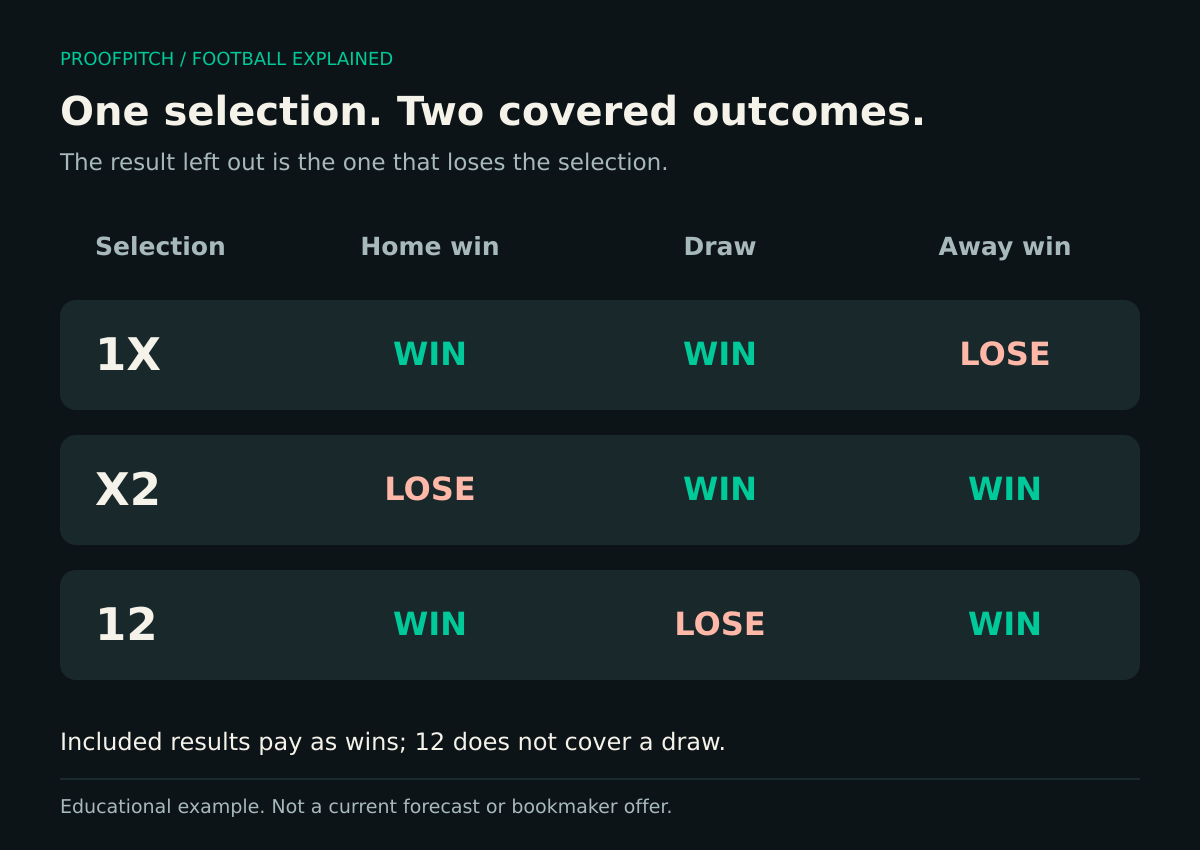
Each row excludes one result. Probability depends on that excluded result, not simply on the number of outcomes covered.
Double chance 1X: home win or draw
For a hypothetical match listed as Home FC vs Away United, 1X means Home FC avoids defeat. Home results such as 1–0 or 3–1 win; draws also win. An away victory loses the selection.
The double chance 1X label does not mean “home team to score first” or “home team to win one half”. Check the full market name rather than guessing from a compact slip label.
Double chance X2: draw or away win
X2 covers Away United avoiding defeat. It excludes the home win. The “2” refers to the away side as listed in that event, not to a team you happen to support.
Use the listed order at a neutral venue: the first-listed side can still be designated “home” for betting purposes even without a home-ground advantage. [2]
Double chance 12 meaning: home or away
Home or away double chance means either team wins; a draw loses. “12” is one selection. It is not the exact score 1–2, a two-match accumulator or a qualification bet.
There is no special refund for a level score in standard 12. If your intention is “my team wins, but I get my stake back on a draw”, read the Draw No Bet comparison instead.
How double chance settles on a bet slip
A few hypothetical scorelines make the notation easier to remember:
| Score at the end of the selected period | Result type | 1X | X2 | 12 |
|---|---|---|---|---|
| 2–0 | Home win | Win | Lose | Win |
| 1–1 | Draw | Win | Win | Lose |
| 0–0 | Draw | Win | Win | Lose |
| 0–2 | Away win | Lose | Win | Win |
These rows apply the market definitions above. A goal total alone does not settle double chance: 2–2 and 4–4 are still draws.
Total return is different from profit
For decimal odds, total winning return = stake × odds. Net profit on that winning selection is total return minus the original stake.
At hypothetical odds of 1.24, a ₦1,000 stake returns ₦1,240, including the stake; the profit is ₦240. A separate R100 example at the same odds returns R124, with R24 profit. These are separate illustrations, not a currency conversion.
If the excluded result happens, a standard settled losing selection returns zero and loses the stake. All monetary examples here exclude taxes, fees, bonuses and special settlement offers; check any deductions or terms that apply to your actual slip.
Which part of the match counts?
Ordinary full-time football result markets normally use 90 minutes plus stoppage time, excluding extra time and penalty shootouts unless expressly stated. A first-half or extra-time market uses its own named period. Operator rules and the accepted selection wording control settlement. [2]
For example, a cup tie can finish level after regulation and produce a winner in extra time. A standard 90-minute 12 selection still loses on the regulation draw. “To qualify” answers a different question. Postponed or abandoned fixtures require the operator’s specific rules; there is no universal voiding deadline assumed in this guide.
Worked example: turn 1X2 odds into double-chance probabilities
Start with a hypothetical full-time market:
| 1X2 outcome | Decimal odds | Raw implied probability |
|---|---|---|
| Home win | 2.00 | 50.00% |
| Draw | 3.00 | 33.33% |
| Away win | 4.00 | 25.00% |
| Total | sum of the three | 108.33% |
These are invented teaching prices for one coherent market, not a forecast for an actual fixture.
Step 1: calculate the implied probabilities and overround
Convert each decimal price using implied probability = 1 ÷ odds. Using unrounded values, the sum is:
1/2 + 1/3 + 1/4 = 13/12 = 1.083333…
The three match results are mutually exclusive and collectively exhaustive: exactly one occurs in the selected period. Their actual probabilities must sum to one. The reciprocal prices sum above one, so this market has an 8.33% overround: (13/12 − 1) × 100.
That is a property of this set of quoted prices. It is not a claim that the bookmaker earns exactly 8.33% of every stake or that each selection carries an identical disadvantage.
Step 2: remove the overround with a stated assumption
One transparent approximation is proportional normalization: divide each raw implied probability by their total.
| Outcome | Normalization | Adjusted probability |
|---|---|---|
| Home | (1/2) ÷ (13/12) = 6/13 | 46.15% |
| Draw | (1/3) ÷ (13/12) = 4/13 | 30.77% |
| Away | (1/4) ÷ (13/12) = 3/13 | 23.08% |
This removes the aggregate overround by assumption. It does not recover the true probabilities, prove the market is accurate or replace an independently tested prediction model. Different margin-removal methods can give different estimates, especially when pricing is uneven across favourites and outsiders.
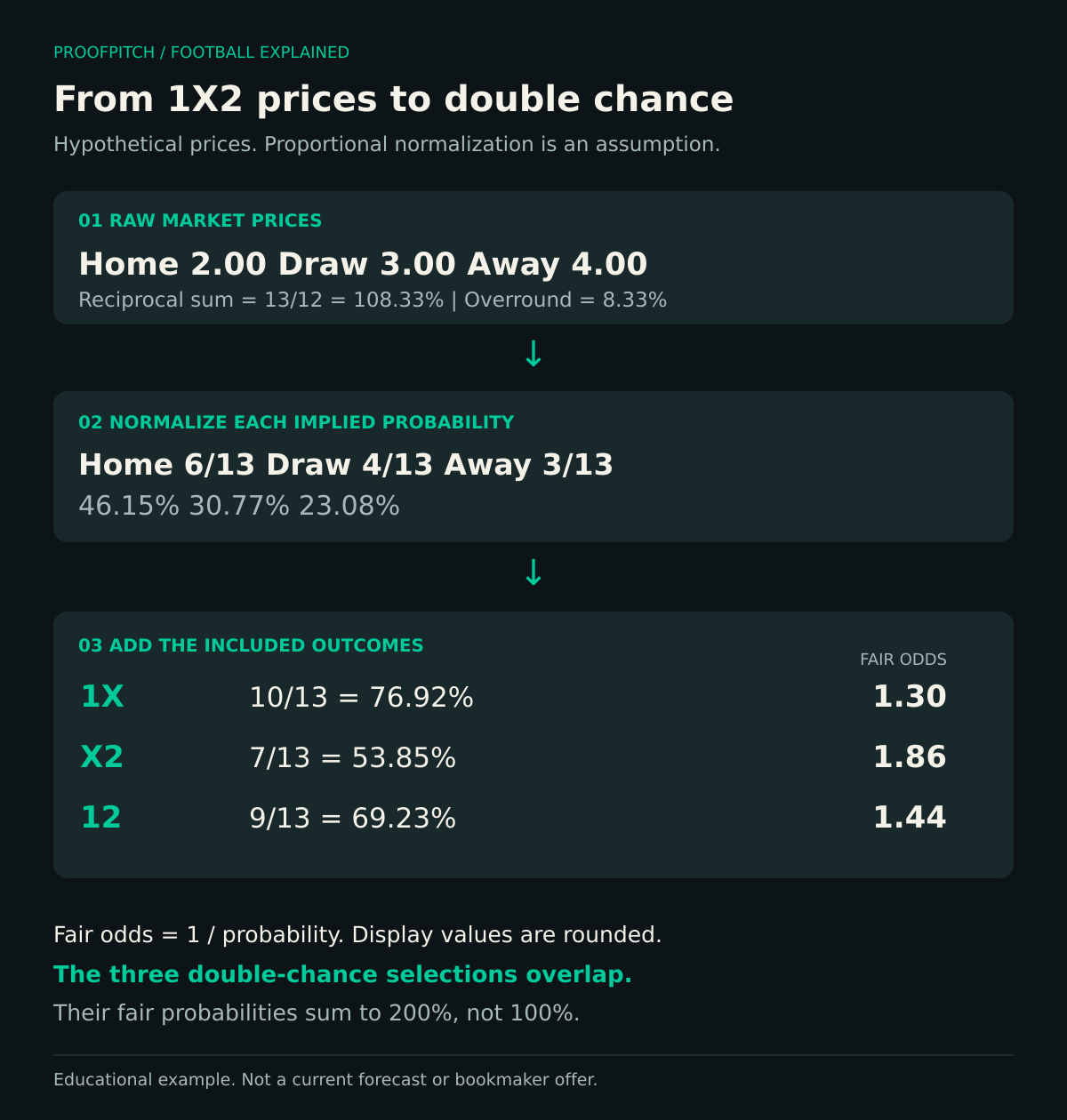
Original calculation: normalized probabilities are 6/13, 4/13 and 3/13. Rounding is for display only. The overlap note in the last line is explained in the section below.
Step 3: add the two outcomes you actually cover
Home, draw and away cannot happen simultaneously as final match results. You can therefore add the two relevant probabilities:
- P(1X) = P(home) + P(draw) = 10/13 = 76.92%.
- P(X2) = P(draw) + P(away) = 7/13 = 53.85%.
- P(12) = P(home) + P(away) = 9/13 = 69.23%.
A useful cross-check is the complement: 1X is 1 − P(away), X2 is 1 − P(home), and 12 is 1 − P(draw).
If you start with a model’s own coherent probabilities rather than bookmaker odds, apply the same addition directly. Do not remove bookmaker overround from probabilities that were never derived from bookmaker prices. Make sure all three estimates refer to the same match, time period and model version.
Step 4: convert the probability to fair odds
For these win-or-lose selections, fair decimal odds = 1 ÷ estimated probability. That produces 1.30 for 1X, approximately 1.8571 for X2, and approximately 1.4444 for 12.
“Fair” means break-even if the probability estimate is correct, before the exclusions already noted. A bettor may require a larger margin for model error. Fair odds are not automatically a suitable minimum accepted price.
Why adding the three double-chance prices is misleading
The three double-chance selections overlap. A home win wins both 1X and 12; a draw wins both 1X and X2; an away win wins both X2 and 12.
Consequently, fair double-chance probabilities sum to 200%, twice the total of the three match results. Each original result has been counted twice. This is an algebraic property, not a betting advantage.
Do not add 1/odds(1X) + 1/odds(X2) + 1/odds(12) and subtract one as though these were three separate final outcomes. That is not the standard three-way overround calculation. Use a coherent underlying 1X2 market for the example above, or compare an individual offered price with the estimated probability of its own selection.
Double chance vs Draw No Bet
The distinction is what happens on a draw. Double chance can pay a full winning return on that result; Draw No Bet returns the original stake. Pinnacle’s market definitions explicitly describe the DNB draw refund. [3]
For a full side-by-side guide, see Draw No Bet vs Double Chance. Compare home-side 1X with home Draw No Bet using a hypothetical 100-unit stake and the fair prices from the same probability example:
| Match result | Home 1X at 1.30: total return | Home DNB at 1.50: total return |
|---|---|---|
| Home win | 130; net +30 | 150; net +50 |
| Draw | 130; net +30 | 100; net 0 |
| Away win | 0; net −100 | 0; net −100 |
Neither column is a bookmaker offer. The table explains why you cannot compare only the price numbers and conclude that the higher one is better: they buy different settlement conditions.
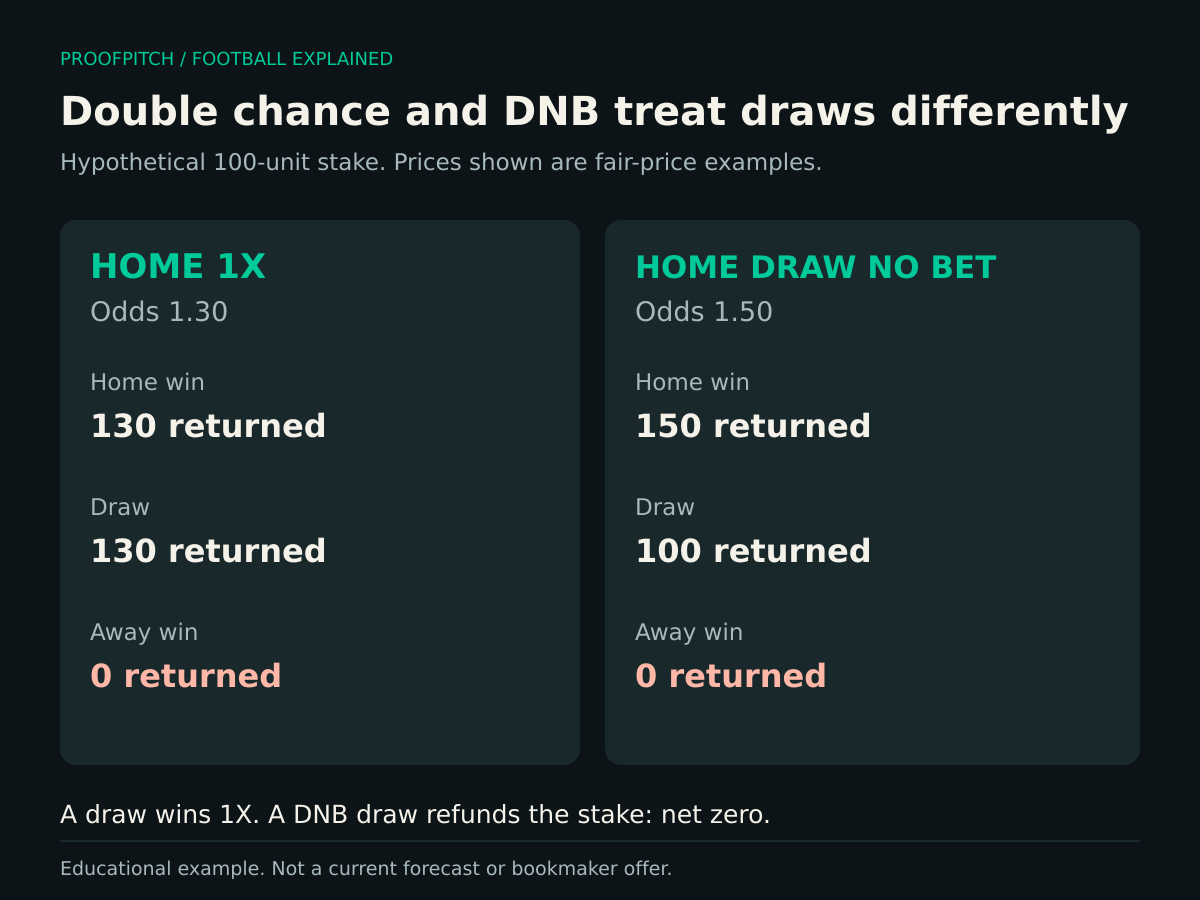
The same estimated 1X2 distribution underlies both columns. A refund returns capital; it does not produce profit.
For home DNB, the unconditional chances are a 6/13 win, 4/13 refund and 3/13 loss. Its fair price is (1 − P(draw)) ÷ P(home) = (9/13) ÷ (6/13) = 1.50.
If a dashboard excludes refunded draws, the home win probability among decisive results is 6/9 = 66.67%. That is not the 76.92% probability of 1X. Check whether a displayed percentage includes draws, excludes pushes or measures a different market altogether.
For equivalent match periods, home Asian handicap +0.5 has the same win/loss outcomes as home 1X; away +0.5 matches X2. Handicap 0/DNB has a refund state. Similar-looking labels still need their own settlement and period checks.
When double chance is a poor choice
The meaning of double chance in betting is about coverage. It does not answer whether the selection is well priced.

Conceptual illustration. Assess the price separately from the chance of the event happening.
The price is too low for the estimated probability
Return to our 1X estimate of 10/13, or 76.92%. At hypothetical offered odds of 1.24, the break-even probability is 1/1.24 = 80.65%.
The event can be likely and still be unattractive at that price. With a 100-unit stake, expected net is:
(10/13 × 24) − (3/13 × 100) = −4.62 units.
This is an average over repeated comparable situations under the assumed probabilities, not a prediction that the next bet loses 4.62 units. A single settled bet in this example returns either a 24-unit profit or a 100-unit loss.
Small prices can hide how many wins a loss erases. At 1.20, five 100-unit winning singles produce 100 units of combined profit; one 100-unit losing single removes it. That arithmetic does not depend on which teams are involved.
Assuming 12 must be the most likely option
In our example, 1X has a higher probability than 12: 76.92% versus 69.23%. There is no permanent ranking of the three options. The most probable selection excludes the least probable underlying result.
A useful counterexample is a hypothetical low-scoring match with a 35% home chance, 40% draw chance and 25% away chance. Then 1X is 75%, X2 is 65%, and 12 is only 60%, the least likely of the three. An attacking reputation or a “must-win” storyline is not a substitute for estimating the draw probability.
Adding more legs to make the payout look worthwhile
For a standard all-win accumulator, one losing leg loses the ticket, subject to its applicable terms. [3] Double-chance legs do not change that structure.
If five independent selections each have a genuine 80% chance, the chance all five win is 0.8⁵ = 32.768%. Independence is an explicit teaching assumption; real selections can be related. Do not treat this calculation as an estimate for an actual accumulator or add the individual percentages together.
The model or price cannot be checked
A percentage without the selected market, publication time or an explanation of the data is hard to assess. A price captured earlier may no longer be available. A retrospective test also answers a different question from a forecast recorded before kickoff.
Keep live, pre-match-recorded history separate from retrospective testing. Check the full record and relevant sample size instead of inferring reliability from a few successful slips. None of the illustrative probabilities in this article is a claimed ProofPitch hit rate.
Double chance and both teams to score
Double chance and both teams to score is a combined condition: the chosen double-chance result must happen and both teams must score, when the BTTS selection is Yes. The official BTTS definition requires a goal from each team. [3]
For 1X + BTTS Yes, a hypothetical 1–1 or 2–1 succeeds, but 1–0 fails the BTTS part and 1–2 fails the 1X part. For 12 + BTTS Yes, 2–1 succeeds while 1–1 fails 12. Plain double chance is therefore not interchangeable with this combined market.
Mathematically, P(1X and BTTS) = P(1X) × P(BTTS given 1X). Multiplying the standalone 1X and BTTS percentages assumes independence; do not make that assumption silently. This is a separate analysis from the basic market covered here; our guide to both teams to score (BTTS / GG) covers that side. Check the complete combined-market label on the bet slip; the double-chance abbreviation alone is insufficient.
How to assess a double chance prediction
A useful double chance prediction identifies the selection and its probability, then explains what could make that estimate wrong. A list of 1X or X2 labels alone is not enough. For how probabilities are produced in the first place, read our guide to mathematical football predictions.
Before relying on an analysis, check:
- Selection and period: the exact side covered, excluded result and match segment.
- Probability basis: a tested model, an explicitly normalized market estimate, or a clearly stated judgement.
- Relevant context: home/away performance, opponent strength, rest, confirmed absences and expected line-ups where available.
- Model usage: whether those factors actually enter the model or are shown only as additional context.
- Price and timestamp: the current available quote, any calculated reference price and the distinction between them.
- Validation: forecasts recorded before the event, a visible sample size and an honest explanation of errors.
Reading a ProofPitch price: on a ProofPitch forecast card, the price is a calculated price: the market price with a 5% margin added (see the methodology). It is not a bookmaker quote, and it is not the same as the no-margin fair odds in this article’s examples. Verify the price actually offered on your bet slip rather than treating a calculated figure as one you can place.
You do not need to place a bet because an analysis exists. If the probability, price or settlement conditions are unclear, leaving the match alone is a valid outcome of the analysis.
Frequently asked questions
What does double chance mean in betting?
It means one selection covers two match results. Read the label as “or”: home/draw, draw/away, or home/away. The three combinations have different probabilities because they exclude different results. [1]
Does double chance include extra time?
Usually not for a standard full-time result selection. Read its named period and any special wording before using the regulation-time examples in this guide. [2]
Is 12 a good bet?
Only the estimated draw probability and the available price can help answer that. Its chance is 1 − P(draw). In the worked example it is 69.23%, but its probability and value will change from match to match.
Is 1X better than X2?
There is no universal winner. 1X excludes the away win; X2 excludes the home win. Compare each selection’s own probability with its price. A higher success probability can come with a smaller return that does not compensate for losses.
Can double chance lose if the match ends 0–0?
Yes: the 12 option loses. A score of 0–0 is a draw. Use the outcome matrix above rather than interpreting “double” as cover for every result.
Is double chance the same as two separate bets?
No. A standard double-chance selection has one stake and one accepted price. Placing separate home and draw bets divides your money and uses different prices; the payout depends on that allocation.
Can I calculate double chance from 1X2 odds?
You can form an estimate: convert odds to implied probabilities, state how you remove overround, then add the relevant pair. Treat that as a market-derived estimate, not a discovery of the true chance.
A final check before accepting any selection
Translate the label, name the one losing result, confirm the period, and compare your estimated probability with the actual price. If comparing DNB, map the draw payout first. If adding BTTS, assess the joint event rather than the two markets separately.
For the next step, explore ProofPitch’s football analysis and use this checklist to interpret the numbers you see. This is a link to our own service; no third-party affiliate links are included in this guide.
18+ · Educational information, not a promise of results or personal financial advice. Only participate where legally permitted. Set affordable limits, avoid chasing losses, and stop if gambling is affecting your wellbeing.
Sources and editorial method
Rules checked 17 October 2026. These operator references explain market conventions; they do not establish that an operator is available or licensed in Nigeria, South Africa or any other reader’s location.
- bet365: What is Double Chance in betting? — basic two-outcome structure.
- bet365 Soccer Rules: 90 Minutes Play and Double Chance — period, labels and listed-team convention. Follow your operator’s own current market terms.
- Pinnacle: Bets offered — Double Chance, Draw No Bet, BTTS and multiple-bet definitions.
The monetary examples, normalized probabilities and counterexamples were constructed for this guide and recalculated from their stated assumptions. The margin-removal method is illustrative. Text and conceptual cover art were produced with AI assistance; numerical diagrams were generated from checked calculation data.