Both teams to score (BTTS / GG / Goal-Goal): what it means
Understand BTTS and GG, how Yes/No bets settle, how to estimate the probability, and how double chance combinations change the winning conditions.

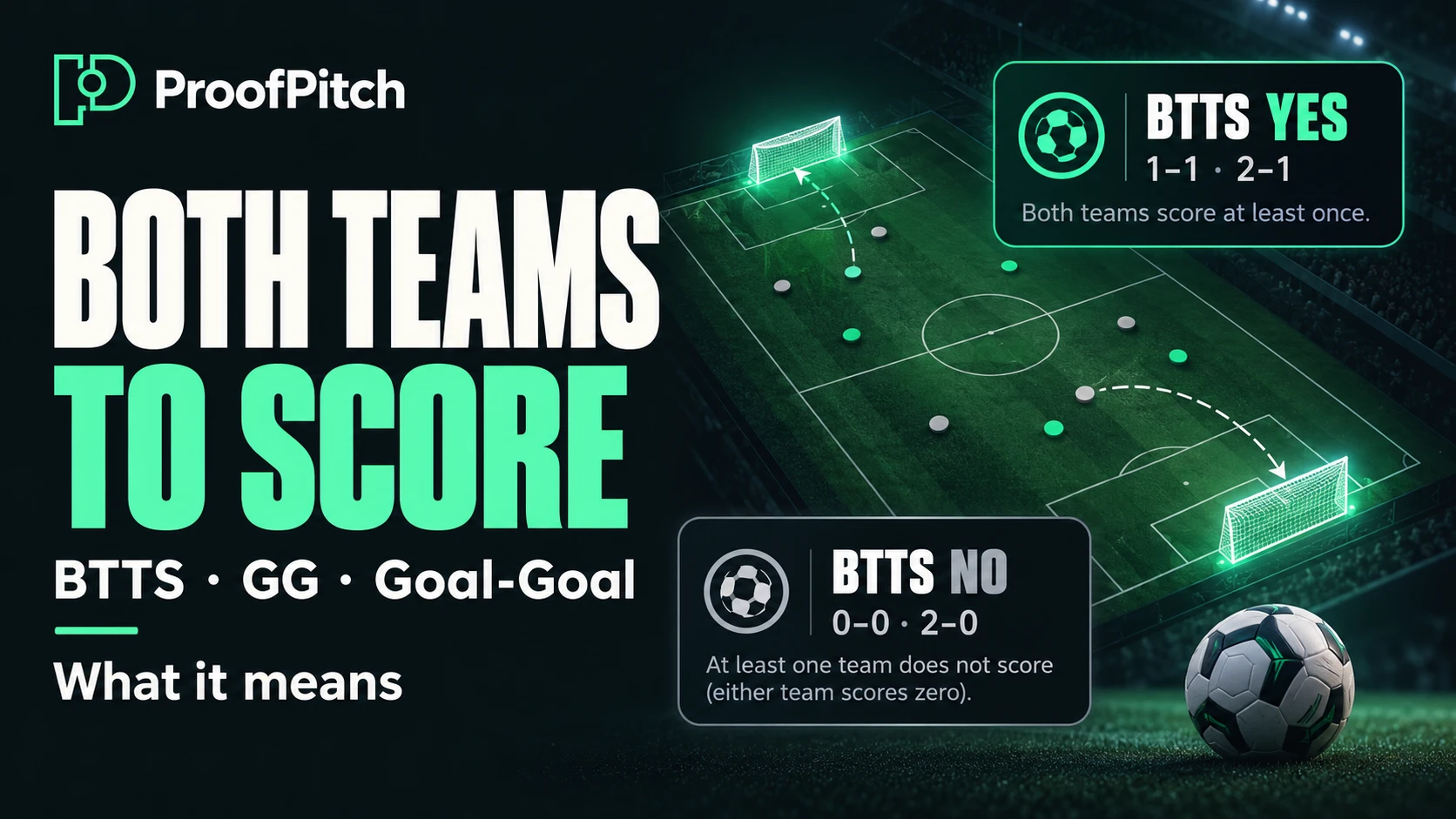
Both teams to score (BTTS) asks whether each team will score at least once during the selected period. BTTS Yes wins when both sides score; BTTS No wins when one or both finish without a goal. For a standard full-match market, read the score after normal time plus stoppage time, subject to the operator’s rules. A 1–1 is Yes. A 3–0 is No.
In Nigerian football-betting language, a GG prediction or goal goal prediction usually refers to BTTS Yes. NG commonly labels the No selection. Bet9ja’s market glossary explicitly uses GG/NG in this way. [9] Always read the wording on the slip: a first-half market or a combination has different conditions from ordinary full-match BTTS.
This guide explains settlement first, then shows how to estimate a BTTS probability from two expected-goal rates, compare that estimate with odds, and understand double chance combinations. The numerical examples are hypothetical, not current match tips or ProofPitch performance figures.
Editorial illustration. It represents the question “will both sides score?” and contains no match data.
BTTS Yes and No: how the market settles
Ignore who wins the match. Check whether either side has a zero in the final score for the period you selected. Betway’s South African BTTS explanation gives both scoring and clean-sheet examples, including a goalless draw. [1]
| Score after the selected period | BTTS Yes / GG | BTTS No / NG | Why |
|---|---|---|---|
| 0–0 | Loses | Wins | Neither side scores |
| 1–0 or 0–1 | Loses | Wins | One side finishes on zero |
| 1–1 | Wins | Loses | Each side scores once |
| 2–0 or 0–2 | Loses | Wins | Several goals, but only for one side |
| 2–1 or 1–2 | Wins | Loses | Both sides score |
| 2–2 or 3–1 | Wins | Loses | The winner and total do not change the BTTS condition |
BTTS No does not mean “no goals anywhere”. It means at least one team does not score. That distinction explains why 0–0, 1–0 and 4–0 all satisfy No.
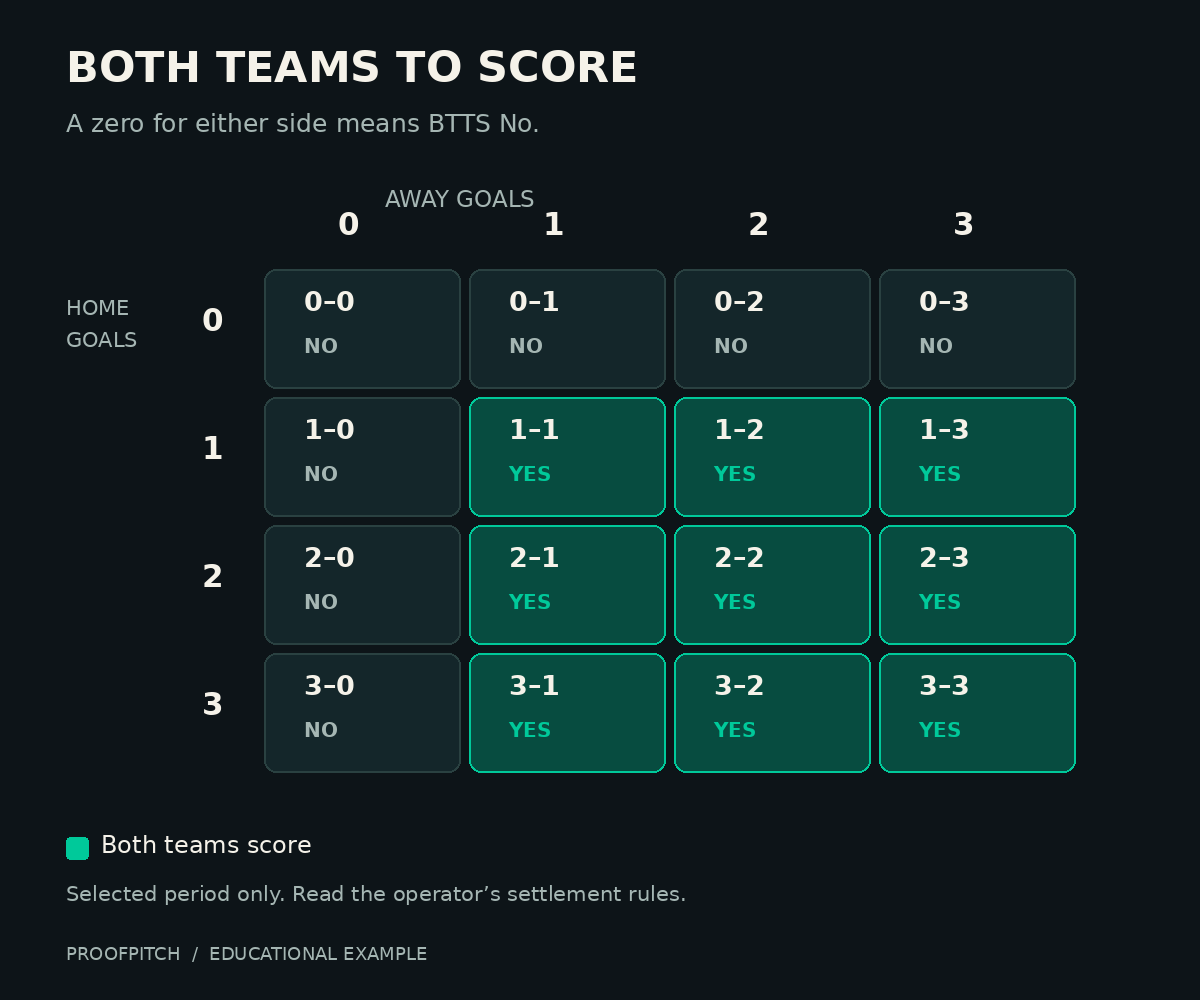
Educational score map. The grid illustrates the settlement condition; it is not a probability forecast.
Does stoppage time count? What about extra time?
For the ordinary 90-minute market, a goal in second-half stoppage time counts. Extra time and the penalty shootout are separate. The bet365 normal-time rule explicitly includes added time and excludes those later periods unless the market states otherwise. This is a cited rule example, not a substitute for your own operator’s terms. [2]
A cup tie can finish 1–0 after normal time and 1–1 after extra time. The ordinary full-match BTTS Yes selection still loses on the 1–0 normal-time score. A separately named extra-time market needs its own reading; it may count only that period.
Stoppage time extends a half to account for lost playing time under IFAB Law 7. A shootout takes place after the match under Law 10. Do not add shootout kicks to the match’s BTTS score. [3] [4]
Own goals, penalties, VAR and red cards
An own goal is credited to the opposing team. Betway’s BTTS explanation specifically describes that treatment. If the home side leads 1–0 and its defender scores an own goal, the credited score becomes 1–1: both teams now have a goal. Individual goalscorer markets can have different exclusions; do not apply those exclusions to a team-scoring market. [1]
A penalty scored during the included playing period changes the match score. A shootout kick does not. A goal disallowed after a VAR review does not remain part of the confirmed score.
A red card does not itself fulfil or cancel the BTTS condition. It can change the football situation and make a pre-match estimate less useful. If the match continues normally, examine its credited goals; if it is abandoned, the abandonment rules become relevant.
What happens if the match is abandoned or postponed?
Do not assume every interruption produces a refund. In the bet365 BTTS rule checked for this guide, abandonment after both sides have scored settles Yes as a winner and No as a loser. Without both sides scoring, its stated postponed/abandoned treatment is void. Other operators or products may apply different conditions. [5]
Read the named market’s rules, the scheduled period and any resumption provision before deciding how a ticket should settle. A competition’s decision about replaying or awarding a match is not automatically the bookmaker’s settlement rule. Keep the original slip and timestamp when checking a disputed result. For a void single, the stake is returned rather than paid as winning profit; a void leg in a multiple is handled under that product’s rules. [10]
BTTS is different from over 2.5 goals
BTTS asks who contributes the goals. A total-goals market asks how many goals are scored altogether.
| Score | BTTS Yes | Over 2.5 goals |
|---|---|---|
| 1–1 | Wins | Loses |
| 3–0 | Loses | Wins |
| 2–1 | Wins | Wins |
| 1–0 | Loses | Loses |
These original score examples show why a high-scoring favourite is not enough to justify BTTS Yes. The weaker team still needs a realistic route to a goal. “BTTS and over 2.5” requires both conditions; a 1–1 falls short. “BTTS and under 2.5” is satisfied only by 1–1 in an ordinary completed match.
First-half BTTS is another distinct question. A goal for each side somewhere in the match does not establish that both scored before half-time. Similarly, both teams scoring across the whole game is not the same as both teams scoring in each half.
How to estimate the probability of both teams scoring
A useful starting model estimates two quantities:
- λH: the home team’s expected number of goals in this match.
- λA: the away team’s expected number of goals in this match.
These are forecast rates for the same period. They are not the teams’ current scores, and they should not simply be copied from one previous match.
Start with the right inputs
Consider home and away attacking output, the opponents’ defending, the strength of the teams faced, and the likely players available. Recent goal totals are useful context, but five unusual results can mislead. A penalty-heavy run, a new coach or several matches against weak opponents can distort a simple average.
Expected goals can help describe the chances a team created or allowed. Hudl Statsbomb defines shot-level xG as the estimated likelihood that a particular shot becomes a goal. A historical match’s xG total therefore describes observed chances; turning that history into a forecast for the next opponent requires an additional model. [6]
One transparent baseline can start from league home/away scoring rates and adjust them for each side’s attacking and defensive strength. For example, a home baseline of 1.40 goals, multiplied by an illustrative attack factor of 1.10 and an opponent defensive-concession factor of 1.04, gives about 1.60. That arithmetic demonstrates a model structure; it does not prove that these factors are correctly estimated. Use consistent definitions, enough observations and only information available before the prediction.

Editorial illustration. Assess the scoring prospects of each team separately before combining them.
A simple independent-Poisson calculation
Suppose the home goals and away goals follow independent Poisson distributions. Under that assumption, the chance a side scores no goals is e^(−λ). This follows from the Poisson probability formula at zero goals. [7]
The resulting calculation is:
P(BTTS Yes) = (1 − e^(−λH)) × (1 − e^(−λA))
You first calculate the chance that each team scores at least once, then multiply those chances under the independence assumption.
For a hypothetical match with λH = 1.60 and λA = 1.20:
| Calculation | Result, rounded |
|---|---|
| Home side scores at least once: 1 − e^(−1.60) | 79.81% |
| Away side scores at least once: 1 − e^(−1.20) | 69.88% |
| Both score: 0.798103… × 0.698806… | 55.77% |
| BTTS No: 1 − 0.557719… | 44.23% |
That is approximately 56 BTTS Yes outcomes per 100 comparable matches if the model and its inputs describe those matches well. It is not a statement about what must happen in a particular game.
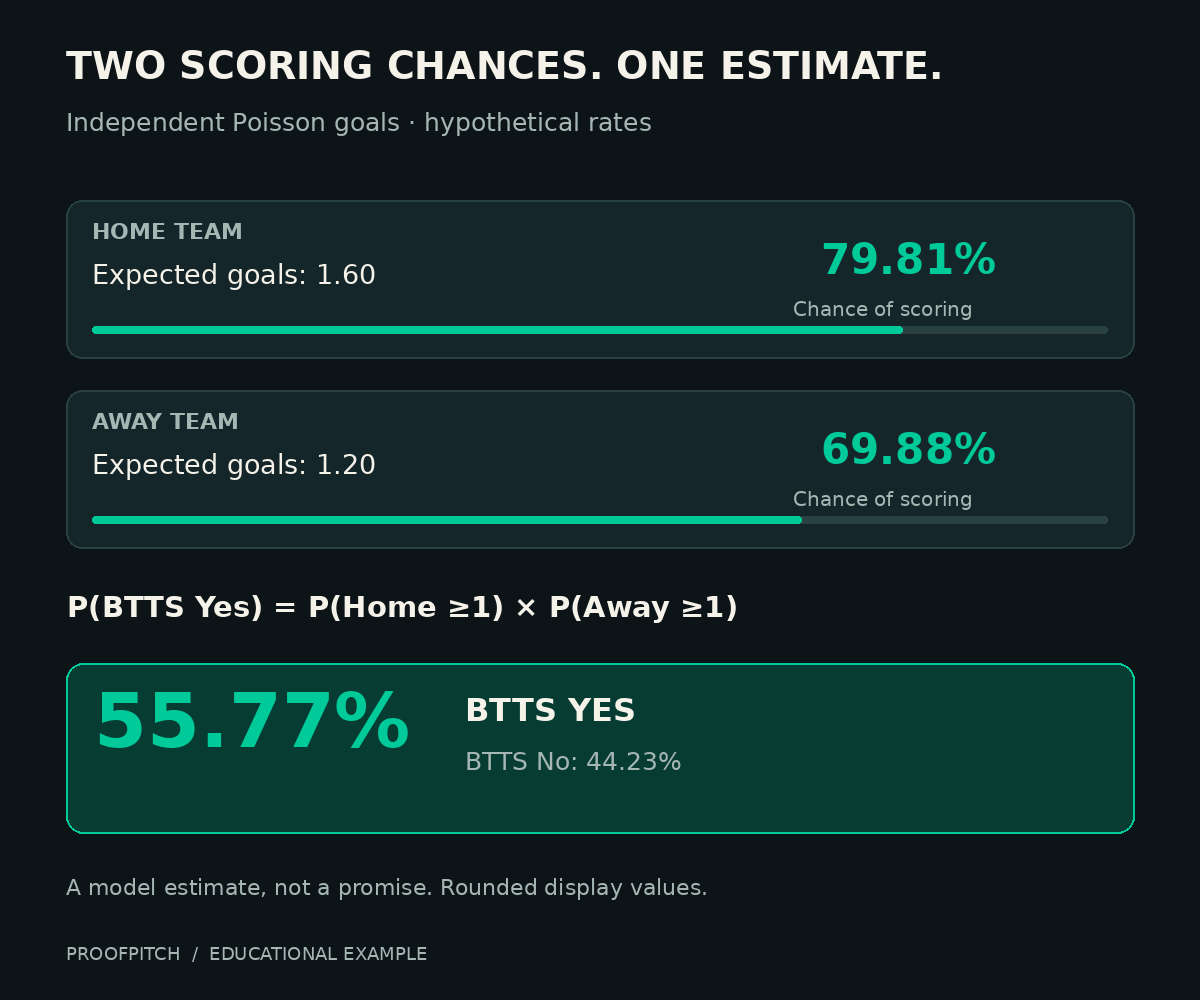
Original calculation under independent Poisson goals. Displayed percentages are rounded; calculations use unrounded values.
A revealing comparison holds the total expected goals at 3.00. A balanced split of 1.50 and 1.50 gives a BTTS estimate of 60.35%. A more uneven split of 2.10 and 0.90 gives 52.08%. The same total does not produce the same BTTS probability: distributing the scoring potential matters.
What this model misses
The independence assumption is a simplification. A goal can change tactics, and an early sending-off can change both teams’ scoring opportunities. The quality of the rates matters as much as the formula. A mathematically correct calculation using poor inputs is still a poor forecast.
Football score models using Poisson regression have a long research history, including Dixon and Coles’ 1997 paper. That academic precedent does not validate a particular app, its inputs or its present-day results. [8]
Check predictions on matches that were not used to fit or tune the model. Group similar forecast probabilities and compare them with later outcomes: estimates near 60% should, over a sufficiently large relevant sample, produce a frequency reasonably close to that level. Keep forecasts recorded before kick-off separate from retrospective model tests. Do not select only successful examples after the results are known.
From a BTTS probability to odds
A probability and a bookmaker’s price answer different questions. The probability estimates how often the outcome happens; the odds determine the return if it happens.
For a completed, two-outcome market without a push, the simple break-even decimal price is 1 ÷ estimated probability. The hypothetical 55.77% estimate above gives about 1.793 using unrounded inputs. This reciprocal is an arithmetic reference, not an available offer.
Compare both sides of the market
Suppose an illustrative bookmaker offers BTTS Yes at 1.90 and No at 1.95 at the same time:
| Step | BTTS Yes | BTTS No |
|---|---|---|
| Raw implied probability: 1 ÷ odds | 52.63% | 51.28% |
| Proportionally normalised estimate | 50.65% | 49.35% |
The raw probabilities add to 103.91%. Dividing each by their sum removes the overround proportionally. This is one simple way to compare a two-sided price with a model; it does not reveal an objectively correct probability or every bookmaker’s pricing method.
For a hypothetical one-unit stake at 1.90, a win returns 1.90 units in total, including the original unit, so net profit is 0.90. A loss returns zero and the net result is −1 unit. Using the unrounded model probability, expected net is:
0.557719… × 0.90 − 0.442281… × 1 ≈ +0.0597 units.
That positive calculation exists only under the assumed probability and price. It can disappear when the estimate is wrong, the price changes, or fees and taxes apply. The example excludes taxes, charges, promotions and voids, and is not a recommended stake or match selection.
Reading a ProofPitch card: the price shown on a forecast card is a calculated price (the market price plus a 5% margin). It is not a bookmaker quote, so keep it separate from a price you actually see at an operator, and note the time you saw it. The simple reciprocal above is a reference calculation and does not replace it.
Double chance & both teams to score: both conditions must happen
A combined market is an intersection. For 1X + BTTS Yes, the home team must avoid defeat and both teams must score. Knowing only that 1X wins does not settle the combination.
| Selection | Conditions | Winning examples | Losing examples |
|---|---|---|---|
| 1X + BTTS Yes | Home win or draw, with goals for both | 2–1, 1–1 | 1–0, 1–2, 0–0 |
| X2 + BTTS Yes | Draw or away win, with goals for both | 1–1, 1–2 | 2–1, 0–1, 0–0 |
| 12 + BTTS Yes | Either side wins, with goals for both | 2–1, 1–2 | 1–1, 2–0, 0–0 |
These examples follow the ordinary meanings of double chance and BTTS, for the same included period. A combination with BTTS No has a different set of winning scores. Read Yes/No as carefully as 1X/X2/12. [2]
Why you should not multiply the two headline probabilities
In general:
P(1X and BTTS) = P(BTTS) × P(1X given BTTS).
The second factor is conditional. Match-result events and both-scoring events depend on the same scoreline, even when a model assumes the two teams’ goal counts are independent.
In the same hypothetical 1.60/1.20 Poisson model:
- P(BTTS Yes) is 55.77%.
- P(1X) is 71.37%.
- Multiplying those marginal probabilities gives 39.80%.
- Adding the score probabilities where home goals ≥ away goals and both are at least one gives 41.25% for 1X + BTTS Yes.
The last figure includes scoring draws and home wins in which the away side also scores. It excludes a 0–0 and all home clean-sheet wins. The difference is not rounding; it comes from conditioning on the same score distribution.
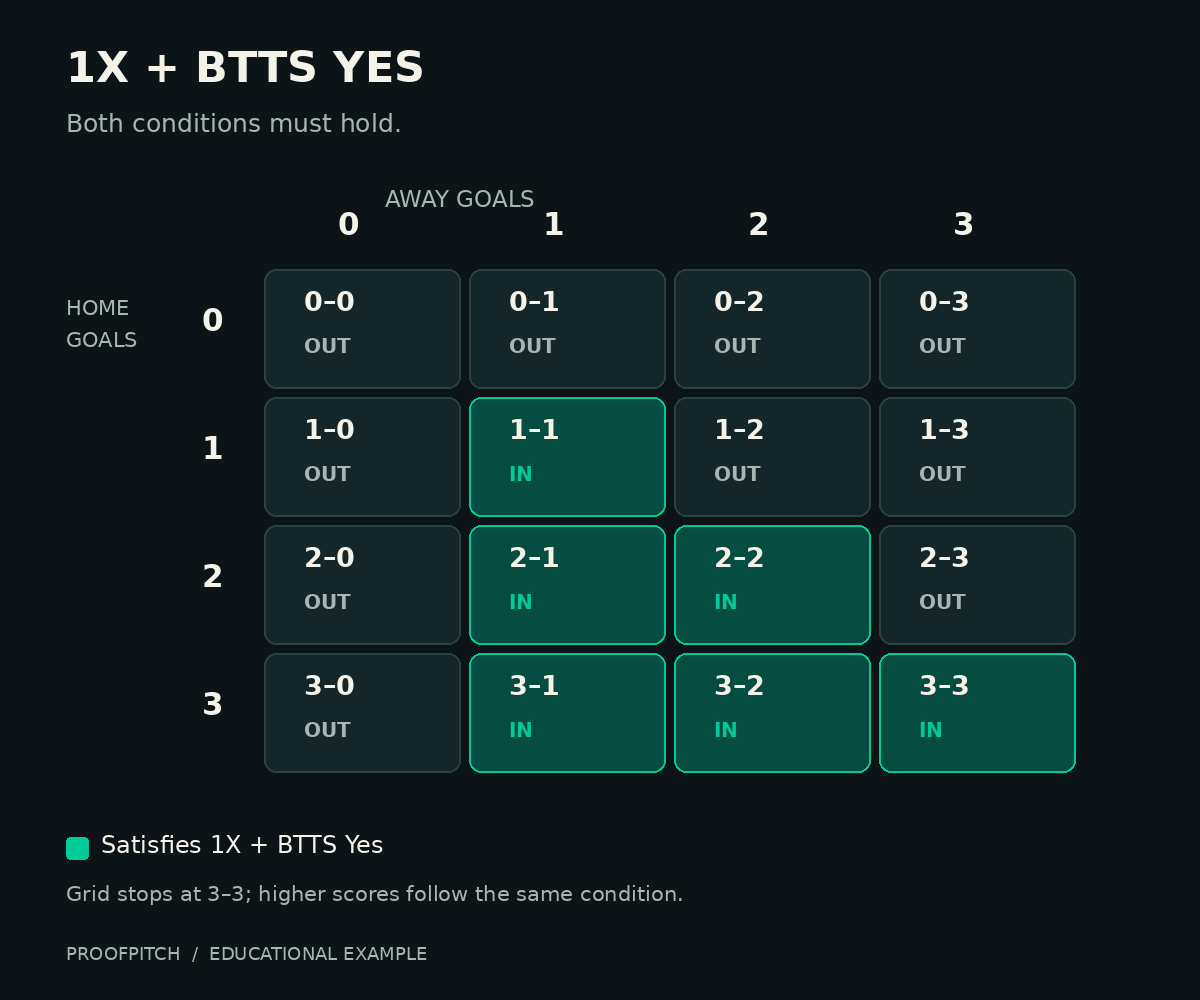
The marked cells satisfy both conditions. The illustration stops at 3–3; the numerical calculation includes higher scores too.
Which leagues have more BTTS? Use verified data
A league name is not a probability. Before trusting a “best league for GG” table, ask which season it covers, how many completed matches it includes, which competitions were mixed together, and when the dataset was last updated.
A credible league comparison should provide:
- The number of eligible completed matches and BTTS Yes results.
- A consistent definition of the period counted.
- Separate competitions and seasons, rather than mixing senior, reserve and youth fixtures.
- Clear handling of missing results, abandoned games and duplicates.
- The observation date and enough data to avoid treating a short run as a stable pattern.
A league’s historical BTTS share is a starting baseline, not the chance for every fixture in that league. A strong favourite against a side that rarely creates chances can differ sharply from the league average.
No numerical league ranking is needed to apply the method. Use a ranking only when its underlying sample can be checked; do not replace missing evidence with a league’s reputation for entertaining football.
BTTS predictions today: how to assess a daily list
A daily list needs fresh fixtures, an unambiguous date and time zone, current team information, a recorded prediction time and a named market. An evergreen explanation cannot establish today’s starting line-ups or available prices.
Before using BTTS predictions, check whether the source published its selections before the match and whether the complete record includes losses, voids and changes. A later screenshot of a successful slip does not establish what was predicted earlier.
Separate three things: the event’s chance, the price available when the decision was made, and the eventual result. A selection can win at an unattractive price; an estimate can be sensible and still lose. Neither a single winner nor a single loser establishes the quality of the process.

Editorial illustration of record checking, not a screenshot or evidence of ProofPitch performance.
“Super GG predictions” and “king of GG prediction”
These phrases appear as promotional descriptions on prediction pages; they do not define a separate standard football market. The wording alone says nothing measurable about a method’s calibration, its sample or its prices. Inspect the underlying selection and record instead of treating the label as a rating.
A list that highlights only successful days cannot establish its full performance. Ask whether cancelled selections, losing picks and the original timestamps remain visible. Also distinguish a model’s estimated percentage from a provider’s claimed historical hit rate: they are different measurements.
GG tips: a practical checklist before trusting the number
- Read the market: Yes or No, full match or a named period, standalone or combined.
- Check both teams’ scoring routes: do not infer BTTS solely from the favourite’s attacking strength.
- Look at the inputs: opponents faced, home/away context, expected-goal rates and available players.
- Check the estimate’s age: line-up changes or an in-play event can make a pre-match assessment stale.
- Compare the actual price: keep bookmaker odds, model probability and any calculated threshold separate.
- Review the complete record: pre-match forecasts and retrospective tests belong in separate groups.
- Allow for uncertainty: if the inputs, period or settlement rules are unclear, leave the selection alone.
Frequently asked questions
What does “prediction BTTS” mean?
It usually means a forecast about whether both teams will score. Confirm whether the prediction selects Yes or No and which playing period it covers. A probability forecast and a list of daily picks are different formats.
Is “both team to score prediction” the same as BTTS?
Yes, the singular wording is commonly used to look for a both-teams-to-score prediction. For ordinary full-match BTTS Yes, each side needs at least one credited goal within the included period.
Does a 0–0 count as BTTS No?
Yes. Both teams finish without scoring, so the condition that at least one team does not score is satisfied. BTTS No also covers clean-sheet wins such as 2–0.
Is a 1–1 draw enough for GG?
It satisfies ordinary full-match BTTS Yes. It does not satisfy a “team to win and BTTS” selection or a BTTS-plus-over-2.5 combination. Any extra conditions on the slip still matter.
If one side has already scored, is BTTS Yes decided?
No. The other side still needs a credited goal within the included period. At 1–0, Yes is not yet fulfilled. At a confirmed 1–1, both-scoring has occurred, but interruption and settlement timing still depend on the market’s rules.
Does high xG mean both sides will score?
No. Historical xG describes chances, and a forecast rate expresses an average, not a promised goal. BTTS Yes also requires a contribution from the other team. Check both rates and the model assumptions.
Can I multiply probabilities when combining different matches?
Only as a model calculation if the selected events are independent; shared team news or other dependencies can undermine that assumption. For two hypothetical independent selections each with a 0.60 chance, both happening has a 0.36 chance. Adding legs does not make their joint outcome more likely.
Can a BTTS model be checked by its win rate alone?
No. Check the forecast probabilities, sample, prices and all outcomes. Calibration asks whether predicted frequencies match observed frequencies; returns depend on prices as well. Keep forward-recorded predictions separate from a model tested after the fact.
Put the explanation into practice
For any BTTS selection, establish the period, estimate each team’s scoring chance, examine the assumptions, and compare like-for-like prices. For a combination, check the scorelines that meet every condition.
Explore ProofPitch with those questions in mind. Read the selected outcome, its estimated probability and any calculated threshold as separate pieces of information, rather than treating one percentage as the whole decision.
18+. Betting involves financial risk. Set limits you can afford, do not chase losses, and step away if betting stops being enjoyable. This article is educational and does not recommend a particular bet or promise returns.
Sources and method
Rules and technical sources were checked on 18 October 2026. The operator references explain specified products and locales; your own market’s terms take precedence. They are reference links, not affiliate links or recommendations to use an operator.
- Betway South Africa: Both Teams to Score, including own-goal examples.
- bet365: normal-time scope and double chance, English-US rules.
- IFAB Law 7: The Duration of the Match.
- IFAB Law 10: Determining the Outcome of a Match.
- bet365: Team Markets, including its BTTS abandonment rule.
- Hudl Statsbomb: Expected Goals explained.
- NIST: Poisson Distribution.
- Lancaster University: Dixon and Coles, 1997 research record.
- Bet9ja: available betting markets, including GG/NG.
- bet365: settlement of singles and multiples, Australian help page.
The probability examples, settlement tables and graphics were prepared for this guide. They use hypothetical inputs and do not describe current fixtures, verified league rankings or a product backtest. The editorial illustrations are AI-generated artwork. Calculations were recomputed programmatically and the operator rules were checked against their public pages.