Draw No Bet vs Double Chance: Difference & Examples
Compare draw no bet and double chance with clear payout examples, 1X/X2/12 meanings, refund rules and probability explanations.

The quick answer: Draw no bet refunds your stake if the match is drawn. Double chance 1X or X2 pays a winning return on a draw. Double chance 12 loses on a draw. If the team you back loses, both its draw no bet and its win-or-draw double chance selection lose. [1][2]
The confusing part is that both markets can protect you from losing on a draw, but they do not pay you in the same way. A refund is your own money coming back. A winning return includes profit at the selected odds.
This guide compares ordinary pre-match, full-time football selections using decimal odds. All teams, prices and probability estimates in the worked examples are hypothetical. They are not ProofPitch forecasts or live bookmaker offers.
What does draw no bet mean?
Draw no bet, often shortened to DNB, is a selection on a team to win with a refund if the match ends level. A team win pays at the DNB odds; a defeat loses the stake. A draw produces no profit and no loss on an ordinary cash single. [1]
You may see 1 DNB for the home team and 2 DNB for the away team. Bet9ja's own market guide uses these labels. “Away draw no bet” does not mean any away goal or any away result: the away team must win for a winning payout. [1]
The word “no” can make the name sound like a prediction that there will be no draw. It is not. It describes how the selection is settled if a draw happens.
What does double chance mean?
Double chance covers two of the three full-time results. The symbols tell you which two: 1 is a home win, X is a draw and 2 is an away win. [1][2]
| Selection | Wins when | Loses when |
|---|---|---|
| 1X | Home win or draw | Away win |
| X2 | Away win or draw | Home win |
| 12 | Either team wins | Draw |
12 is the important exception: it does not cover the draw. “Double chance” alone is not enough to tell you whether a 0–0 result wins. Read the selected pair. A void caused by an abandoned event is a separate issue from the ordinary result settlement shown here.
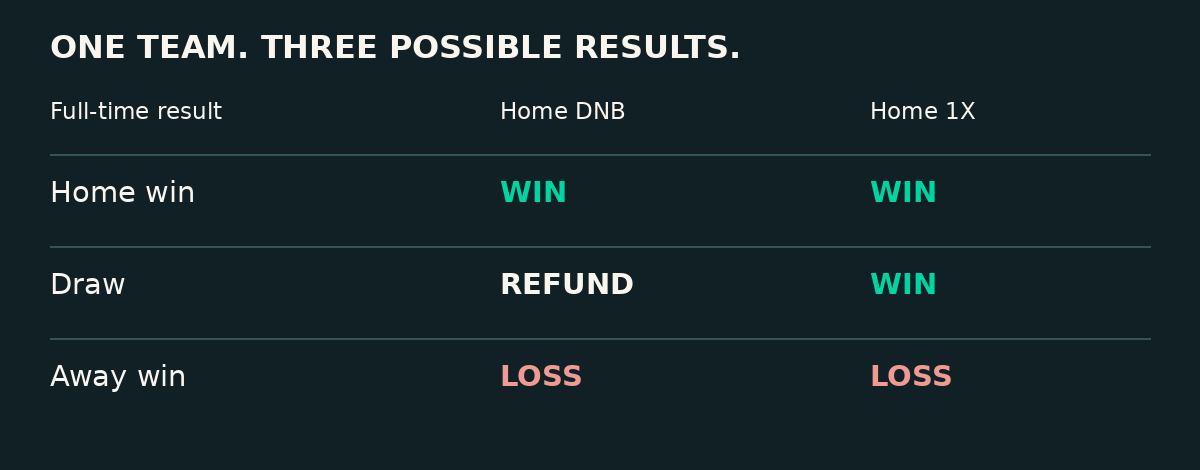
Backing the same home team: compare all three outcomes.
Draw no bet vs double chance: the same match, two returns
Imagine Home FC vs Away FC. You are comparing Home FC DNB at 1.80 with Home FC or draw (1X) at 1.40. Use a stake of 100 units; the arithmetic is identical whether those units are naira, shillings, cedis or rand.
For a winning cash single, total return equals stake multiplied by decimal odds. Net profit equals total return minus stake. The following calculations are worked examples, not quoted prices.
| Full-time result | Home DNB at 1.80 | Home 1X at 1.40 |
|---|---|---|
| Home wins 2–1 | 180 returned; +80 profit | 140 returned; +40 profit |
| Draw 1–1 | 100 refunded; 0 profit | 140 returned; +40 profit |
| Away wins 0–1 | 0 returned; −100 loss | 0 returned; −100 loss |
Notice what has not changed: both selections lose the full stake if Away FC wins. Double chance 1X adds a profitable draw outcome; it does not protect against a home defeat. The DNB price in this example pays more on a home win but nothing extra on a draw.
Backing the away team reverses the win and loss rows: compare Away FC DNB with X2, not with 1X.
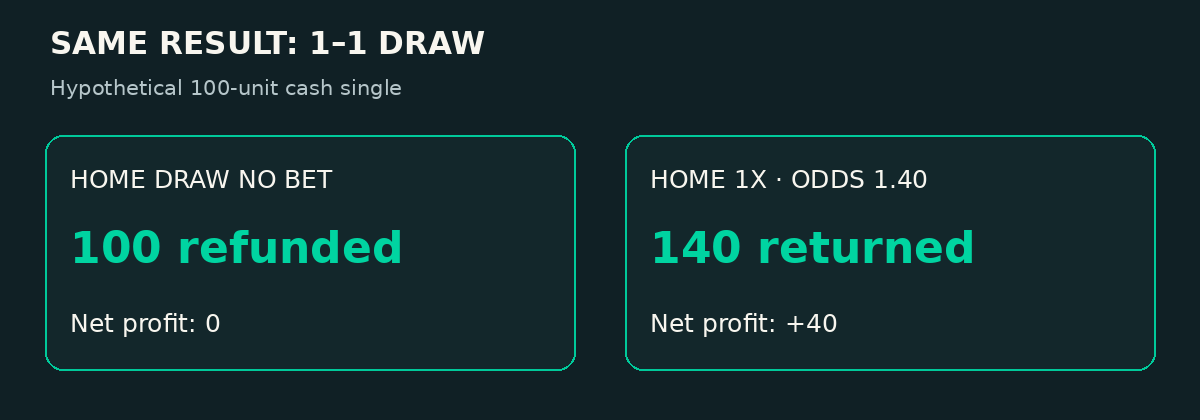
Same draw, different return. Educational example only.
Why are the odds different?
For the same team and settlement period, DNB typically offers a higher price than its win-or-draw double chance counterpart. The draw earns a profit under 1X or X2 but only returns the stake under DNB. Betway's explanations describe this usual relationship. Prices can still differ between operators and times; compare the actual offers rather than assuming a fixed gap. [3]
Higher odds alone do not establish better value. A price must be considered alongside the probabilities of a win, draw and loss. Lower odds do not make a selection guaranteed either.
Does double chance really have a 66.7% chance?
A football match has three result labels, but they are not equally likely. Covering two of them does not automatically create a 66.7% chance of winning. The teams and the draw each need their own probability estimate.
Here is an original arithmetic example. Suppose your estimates for Home FC are a 50% win chance, 25% draw chance and 25% loss chance. These add to 100% and describe the same possible match outcomes for both markets.
- Home DNB: 50% win, 25% refund, 25% loss.
- Home 1X: 75% win and 25% loss.
Among DNB cases that do not end in a refund, the estimated winning proportion is 50 ÷ 75 = 66.7%. That is not the unconditional 50% probability of Home FC winning. Always check whether a reported win rate excludes pushes.
Now apply the earlier hypothetical odds to a 100-unit stake:
DNB expected net return 0.50 × 80 + 0.25 × 0 − 0.25 × 100 = +15 units
1X expected net return 0.75 × 40 − 0.25 × 100 = +5 units
At different prices the comparison changes. If DNB were 1.40 and 1X were 1.20, the same estimates would give −5 units and −10 units respectively. Neither would have positive expected net return under those assumptions.
Expected return is a probability-weighted average, not a promise about the next match or next ten matches. The calculation is only as reliable as the estimated probabilities. It also omits fees, taxes, promotions and exchange commission. A model can be wrong, and even a positive estimate can be followed by losses.
The fair-odds calculation
Let W be your team's win probability and D its draw probability. In a simplified model without bookmaker margin or other deductions, zero-expected-profit odds are:
- DNB: (1 − D) ÷ W, provided W is greater than zero.
- Win-or-draw double chance: 1 ÷ (W + D), provided W + D is greater than zero.
For W = 0.50 and D = 0.25, those prices are 1.50 and approximately 1.33. These are calculated reference points for the assumed probabilities, not market recommendations. The DNB formula accounts for refunded draws; simply applying 1 ÷ W would ignore that refund.
Is draw no bet the same as Asian handicap 0?
For the same team, period and ordinary settlement conditions, Asian handicap 0 has the same result pattern as DNB: a win pays, a draw refunds and a loss loses. Asian handicap +0.5 instead wins on a win or draw, matching the result pattern of that team's 1X or X2. Prices need not be identical. [4]
Check the number carefully. Handicap 0, +0.5 and a three-way European handicap are different markets. For in-play Asian handicap, some operators settle only goals scored after placement. Bet365 explicitly applies a remainder-of-game rule. Do not transfer the pre-match examples above to a live selection without reading its rules. [4]
Four settlement details to check
1. Full time is usually regulation time
Ordinary full-time football markets generally use 90 minutes plus stoppage time, excluding extra time and penalties. A team can draw that period and qualify later. A “to qualify” or explicitly extra-time market is different. Check the period printed on the selection. [5]
2. First-half selections stop at half time
First-half DNB concerns the first-half result, not the final score. The first-half draw no bet guide walks through half-time scores and refunds. A 0–0 first half can refund that selection even when the backed team eventually loses 0–2. Do not compare first-half odds with full-time odds as though they refer to the same event. [1]
3. A refund in an accumulator changes the calculation
Under Betfair Sportsbook's standard multiple rules, a void leg is removed and the remaining legs stand: a treble with one void leg becomes a double. A drawn DNB leg therefore does not create a winning DNB payout. The other legs can still lose. Operator-specific bonuses, free bets and bet builders may follow separate terms. [6]
For a hypothetical 100-unit accumulator with winning legs at 1.50 and 1.60 and a void DNB leg, the remaining price is 1.50 × 1.60 = 2.40. Total return would be 240 and net profit 140, before any deductions. If either remaining leg loses, there is no winning accumulator return.
4. A combined market has extra conditions
“Double chance and both teams to score” is not ordinary double chance (see double chance and both teams to score explained). A home-or-draw selection combined with both teams to score would not win on 0–0, even though standalone 1X does. Check every part of the market title and the operator's settlement rules.
How this relates to ProofPitch
Before using a forecast, identify what its probability refers to. A chance of a team winning, a chance of a win-or-draw selection succeeding and a win rate that excludes returned stakes are different numbers. This distinction matters when comparing the model with an outcome history.
A short run of results cannot establish how reliable a probability model is. Read the full history, dates and sample sizes, including losses and pushes. Compare probabilities that refer to the same market and time period before drawing a conclusion.
Explore the analytics behind the numbers
Explore football analysis and learn more about ProofPitch.
Explore ProofPitch Open Telegram bot
Common questions
Does draw no bet refund on 0–0?
Yes, under ordinary DNB settlement for the specified period. A 0–0 result is a draw, just like 1–1 or 2–2. A cash single returns the stake without profit.
Does double chance 12 win on a draw?
No. 12 covers a home or away win. A draw is its losing result. The draw is covered by 1X and X2.
Which is safer: DNB or double chance?
For the same team, DNB and win-or-draw double chance lose on the same opposing-team win. Double chance pays on a draw; DNB refunds. Their prices and payout distributions differ, so “safer” is incomplete without stating what risk you mean.
Is draw no bet more profitable?
Not automatically. Profit depends on actual prices, outcomes and the accuracy of probability estimates. A higher DNB price is not evidence of a profitable selection.
Are the rules the same in Nigeria, Kenya, Ghana and South Africa?
The basic market definitions are widely used, but operator labels, tax deductions, promotion terms and event rules can differ. Read the rules attached to your actual selection. The examples here do not specify any country's tax treatment.
Your final check
- Read the selected team and market: DNB, 1X, X2 or 12.
- Confirm the period: full time, first half or something else.
- Separate total return, profit and refund.
- Check how voids and combined selections are handled.
- Treat probabilities as estimates. Leaving a match alone is always an option.
Related guides
- First-Half Draw No Bet: Meaning, Refunds & Examples: how the refund works when only the first half counts.
- Double Chance & Both Teams to Score: Meaning & Examples: what changes when double chance is combined with BTTS.
Sources and editorial method
Definitions and settlement details were checked against the official operator pages below on 12 October 2026. They are cited as rule references, not endorsements. All numerical scenarios were constructed for this guide and recalculated from the stated inputs. This article was prepared with AI assistance; definitions use the cited operator rules, and the calculations are educational examples.
- Bet9ja — Available Betting Markets: DNB labels and ordinary settlement.
- bet365 — What is Double Chance?: the three selections.
- Betway South Africa — Draw No Bet Meaning: typical pricing comparison.
- bet365 — Asian Handicap rules: zero, half-goal and in-play settlement.
- Betfair — Football 90 Minute Rule: regulation-time scope.
- Betfair Sportsbook — General Rules: void legs in multiples.
18+ or the higher legal age where you live. Educational analytics, not a guarantee of results. Betting involves a risk of loss. Do not use money needed for essentials or chase losses.