EPL football predictions: how to read a Premier League round
See how an EPL prediction model reads form, goals and home advantage, turns them into probabilities, and checks each Premier League round.


EPL football predictions: how to read a Premier League round
Good EPL football predictions do more than place a team name beside a percentage. They define the fixture and calculation time, estimate how often each result could occur, show alternative outcomes, and preserve the forecast after the match so readers can check it.
This page explains how ProofPitch reads a Premier League round. It is a permanent explainer, while the fixtures and forecasts on the live ProofPitch pages change each matchweek. A model probability is an estimate—not a promise about the next result.
What the model calculates for an EPL round
An EPL matchweek is a group of separate fixtures, not one prediction problem. The model processes each match with the same version and information cut-off, then displays the round together so differences are comparable.
The Premier League has 20 clubs, each playing the other 19 once at home and once away. That produces 38 matches per club and 380 league fixtures in a season.[1] A normal round therefore often contains ten matches, although postponed or rearranged fixtures can make a calendar week look different.
For each fixture, the model needs to answer three layers of questions:
- Expected scoring: how many goals should the home and away teams be expected to score on average?
- Outcome distribution: how is probability divided among 0–0, 1–0, 0–1, 1–1 and the other plausible scores?
- Market view: what do those cells imply for home/draw/away, totals, both teams to score and other defined markets?
Team strength is split into attack and defence
League position is a result, not a complete model input. Two clubs can have the same points total while creating and conceding very different numbers of goals.
A goal model can estimate separate attacking and defensive strengths. The home team's scoring rate depends partly on its attack and the visitor's defence; the away scoring rate depends on the reverse matchup. Those estimates should be based only on information available before kick-off.
The precise production feature set can evolve, but a transparent framework should distinguish stable inputs from last-minute information. Typical categories include:
- goals scored and conceded, adjusted for opponent quality;
- shots or expected-goal information where coverage is consistent;
- recent team strength with older matches receiving less weight;
- home and away context;
- rest, schedule congestion and verified team availability;
- the exact calculation time and model version.
More inputs do not automatically create a better forecast. A field that is missing for some clubs, revised after the event or available only for selected matches can introduce bias.
Recent form is weighted evidence, not a streak label
“Won the last three” compresses three different matches into one sentence. It ignores opponent strength, venue, performance and how unusual the results were.
A model can give more weight to recent observations while still using a broader sample. Dixon and Coles developed a dynamic Poisson-regression approach for English football in which team strengths change over time and older results receive less influence.[2] That is more disciplined than deciding after the fact that a particular winning or losing run matters.
Recency must still be tested. Too little history makes the estimate unstable; too much can make it slow to react to a new manager, promoted team or structural change. The weighting rule should be fixed before results are evaluated.
Home advantage is estimated, not assumed to be constant
Home venue can affect scoring expectations, but it should not be treated as an automatic home selection. The size of the home effect changes across seasons, teams and match conditions.
In a simple model, home advantage raises the home scoring rate through a league-level parameter. A richer model may allow the effect to vary, but that extra complexity needs enough data and out-of-sample testing. The output remains a probability distribution: a home win can be the largest of three outcomes while it is still more likely not to happen than to happen.
From expected goals to match probabilities
Once the model has a home goal rate and an away goal rate, it can calculate the probability of each score. A common educational starting point is the Poisson distribution. ProofPitch's full production method may include further adjustments, but the simple calculation shows how a match card is built.
Consider an illustrative EPL-style fixture with:
- home expected goals: 1.62;
- away expected goals: 1.08;
- calculation: independent Poisson before any low-score correction;
- scope: regulation time plus stoppage time, excluding extra time.
The score matrix produces the following rounded probabilities:
| Output | Model probability |
|---|---|
| Home win | 49.92% |
| Draw | 24.74% |
| Away win | 25.34% |
| Over 2.5 goals | 50.64% |
| Both teams to score | 52.97% |
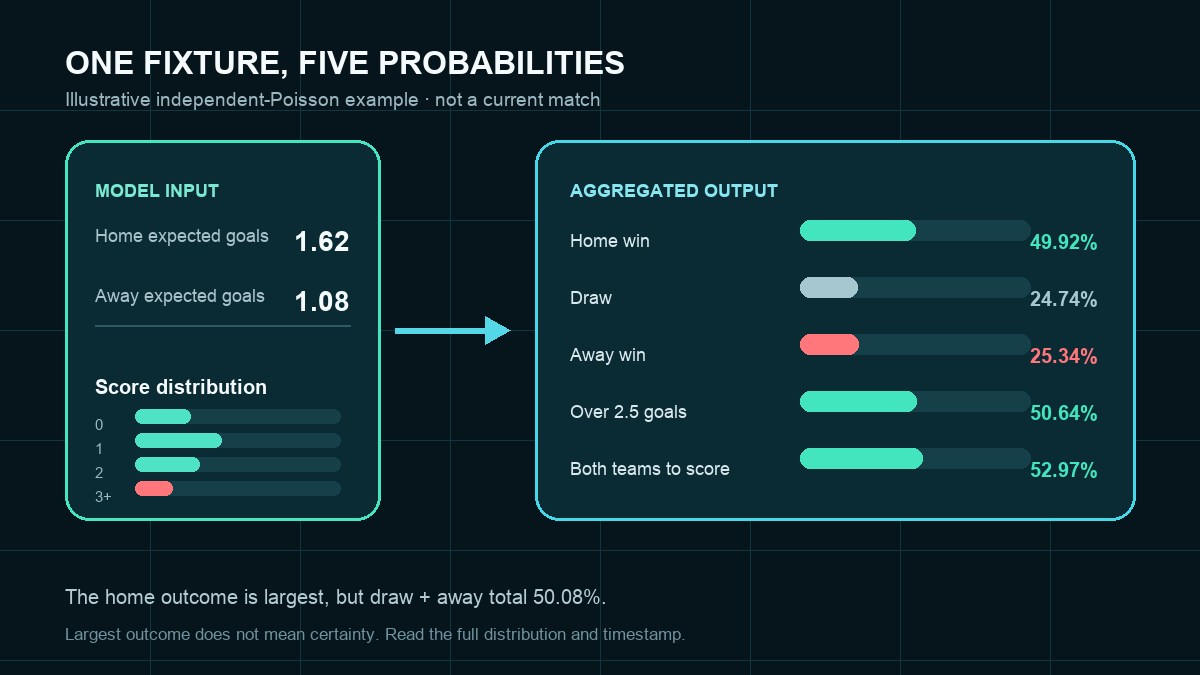
Figure 1. Reproducible independent-Poisson example. It is not a current fixture, ProofPitch performance claim or market price.
The home win is the largest individual 1X2 result, but it is still below 50%. The draw and away win together carry 50.08%. Calling the home team “the prediction” would hide that uncertainty.
The same rule applies across a round. One match may have a concentrated home-win distribution, another may be close to balanced, and a third may show more information in the total-goals distribution than in 1X2. A round page should not force every fixture into the same headline market.
Current Premier League round predictions
The permanent article you are reading explains the method. The changing fixture cards live on ProofPitch.
For every match, check that a forecast card shows:
- teams, competition and scheduled kick-off with timezone;
- calculation timestamp and model version;
- home, draw and away probabilities that sum to approximately 100% after rounding;
- the market definition and settlement period;
- relevant totals or both-teams-to-score probabilities;
- status for scheduled, postponed, started and settled fixtures;
- market reference time where a comparison is displayed;
- links to the preserved result record.
The official Premier League fixture list should be the schedule reference. Dates and kick-off times can move because of broadcast selections, domestic and European competitions, and other calendar constraints.[3] A weekly forecast page must therefore refresh the fixture feed without silently changing an already published forecast.
A practical weekly update sequence
- Fixture sync: confirm the matchweek, dates, kick-off times and postponements against the official schedule.
- Data cut-off: record which matches and team information are included.
- Model run: calculate every fixture with one approved model version.
- Publication freeze: publish probabilities with a timestamp and preserve that version.
- Pre-kick-off update: if approved new information triggers a recalculation, retain both timestamps and label the latest version.
- Settlement: attach the final result and settlement status without rewriting the original forecast.
This separation matters when a match is moved. A fixture date can change while the model version, data window and prior publication record remain auditable.
How to compare probability with price
A model probability and a market price are different objects.
- Model probability is an estimate of how often the outcome should occur under the method and information set.
- Market price is a current quote observed from a specified source and time.
- Calculated card price is ProofPitch's market-based calculation using the documented 5% margin rule.
The calculated card price is not a bookmaker quote. It must remain labelled separately from the model probability and the observed market reference. A difference between model and market is not proof that the model is correct; it is a comparison that may justify checking the inputs, timestamp and uncertainty.
For a margin-free mathematical translation only, a 49.92% model probability corresponds to 1 ÷ 0.4992 ≈ 2.00. That fair-price conversion is not the ProofPitch calculated card price and is not a currently available operator price.
How we check previous Premier League rounds
A retrospective check must remain separate from the live record. They answer different questions.
Live record
The live record contains forecasts actually published before the matches. It should preserve their timestamps, subsequent updates and settled outcomes. This is the closest evidence for how a reader would have experienced the system.
Retrospective check
A retrospective check applies one frozen model specification to a defined historical window. It can provide a larger sample and useful diagnostic detail, but it must control data availability and avoid using information that was not known at the forecast time.
The two datasets should never be merged into one headline percentage. A historical test can contain more matches but does not become a live record.
Metrics that fit probabilistic forecasts
Hit rate alone throws away information. A 51% home-win forecast and an 80% home-win forecast both become the same binary “home pick”, even though the model expressed very different confidence.
A better review includes:
- calibration: among outcomes assigned about 50%, did roughly half occur over a suitable sample?
- Brier score or log loss: did the full probabilities receive appropriate rewards and penalties?
- comparison baseline: did the model improve on a simple league or market benchmark?
- sample definition: were all eligible fixtures included, including postponed and difficult matches?
- time split: was performance measured on matches that came after the training data?
Proper scoring rules assess a probability distribution against the outcome that occurred and encourage honest probability estimates rather than exaggerated confidence.[4]
How to read an EPL forecast card
Use this order rather than starting with the largest number.
- Confirm the fixture. Check the scheduled date, timezone and whether it has moved.
- Read the market. Home win, double chance, total goals and correct score settle differently.
- Read all outcomes. A 46% home probability also means 54% is distributed across draw and away.
- Check the timestamp. Team news and inputs may have changed after calculation.
- Separate probability and price. Do not treat either as the other.
- Inspect the public record. One successful round is not evidence of long-run calibration.
- Check uncertainty. Closely grouped probabilities deserve more caution than a concentrated distribution.
Read how mathematical football predictions work for the full goal-model pipeline, and why an exact score remains difficult for the score-matrix view.
Frequently asked questions
What are EPL football predictions?
They are estimates for Premier League fixtures, usually expressed as probabilities for match result, goals or other defined markets. A complete forecast includes a timestamp, market definition and public result record—not only a team name.
How often is the EPL prediction page updated?
The live forecasts should refresh when the official fixture schedule changes and at the approved model-calculation times. Published versions must retain their original timestamps so updates do not erase the audit trail.
Does recent form decide the prediction?
No. Recent matches can receive more weight, but the model also needs opponent strength, attack, defence, venue and a broader data window. A short streak is evidence, not a complete forecast.
Why can the favourite still have a probability below 50%?
“Favourite” means the largest individual outcome, not certainty or a majority. A home win at 46% can be larger than draw and away separately while those alternatives total 54% together.
Are these Champions League predictions too?
No. This hub is limited to the English Premier League. Champions League fixtures, teams and schedule structure require a separate live competition page and separate evaluation sample.
Are the displayed prices bookmaker odds?
Not when they are labelled calculated card prices. ProofPitch's calculated value uses a documented market-based calculation with a 5% margin. A current operator quote must be sourced and timestamped separately.
Can a model predict every Premier League result correctly?
No. Football outcomes remain uncertain. The model's purpose is to estimate a distribution and make its record measurable, not to remove the chance of an unexpected result.
Where can I check older rounds?
The live record contains forecasts that were published before the matches. A retrospective test is a fixed historical evaluation and is shown separately. Do not combine their headline results.
Follow the round as a probability set
An EPL round is most useful when every fixture is calculated under the same rules and frozen at a clear time. Compare the whole distribution, check the schedule, and judge the model across many published rounds rather than one result.
See ProofPitch's live forecasts and inspect the probabilities, timestamps and public record.
18+ only. Use only where legal. Gambling involves a risk of loss. Set time and money limits, never chase losses, and do not treat predictions as income or financial advice. In South Africa, the National Responsible Gambling Programme provides free support at 0800 006 008.[5] In Ghana, the Gaming Commission lists a toll-free support line at 0800 454 545.[6]
Notes and sources
- Premier League. New to the Premier League? Here's all you need to know. Competition format; checked 31 October 2026.
- Dixon, M. J.; Coles, S. G. Modelling Association Football Scores and Inefficiencies in the Football Betting Market. Journal of the Royal Statistical Society: Series C, 1997.
- Premier League. FAQ — Fixtures. Schedule changes and official update routes; checked 31 October 2026.
- Gneiting, T.; Raftery, A. E. Strictly Proper Scoring Rules, Prediction, and Estimation. Journal of the American Statistical Association, 2007.
- National Gambling Board of South Africa. National Responsible Gambling Programme. Support contact checked 31 October 2026.
- Gaming Commission of Ghana. Gambling, gaming and mental wellness. Toll-free support contact; checked 31 October 2026.