First-Half Draw No Bet: Meaning, Refunds & Examples
Learn first-half draw no bet with half-time score examples, payout calculations, refund rules and a clear comparison with full-time DNB.

First-half draw no bet is settled on the first-half result. Your chosen team leading at half time produces a win, a level score produces a refund, and your team trailing produces a loss. A later comeback does not change that first-half selection.
This guide concerns ordinary pre-match football cash singles. All teams, prices and stakes in the examples are hypothetical, not live offers or ProofPitch results. Operator rules control settlement, particularly for interrupted matches and promotional bets.
What does first-half draw no bet mean?
The period is the key. A full-time DNB selection and a first-half DNB selection can back the same team but ask different questions. The former concerns the full-time result; the latter concerns which team leads at the end of the first half.
You may see labels such as DNB HT, 1st Half DNB or Draw No Bet — First Half. Bet9ja's official market guide describes home and away first-half selections and makes a half-time draw a void outcome with the stake returned. See the DNB HT section.
A void cash single returns your original stake without profit. It is not a winning selection at the displayed odds. Read the period label before comparing two prices: a cheaper or more attractive number can concern a different part of the match.
The same first half, three possible outcomes
Suppose you choose Home FC first-half DNB. The score below is always written home first.
| Half-time score | What happened | Home first-half DNB |
|---|---|---|
| 1–0 | Home FC leads | Win |
| 0–0 | Teams are level | Refund |
| 1–1 | Teams are level | Refund |
| 0–1 | Home FC trails | Loss |
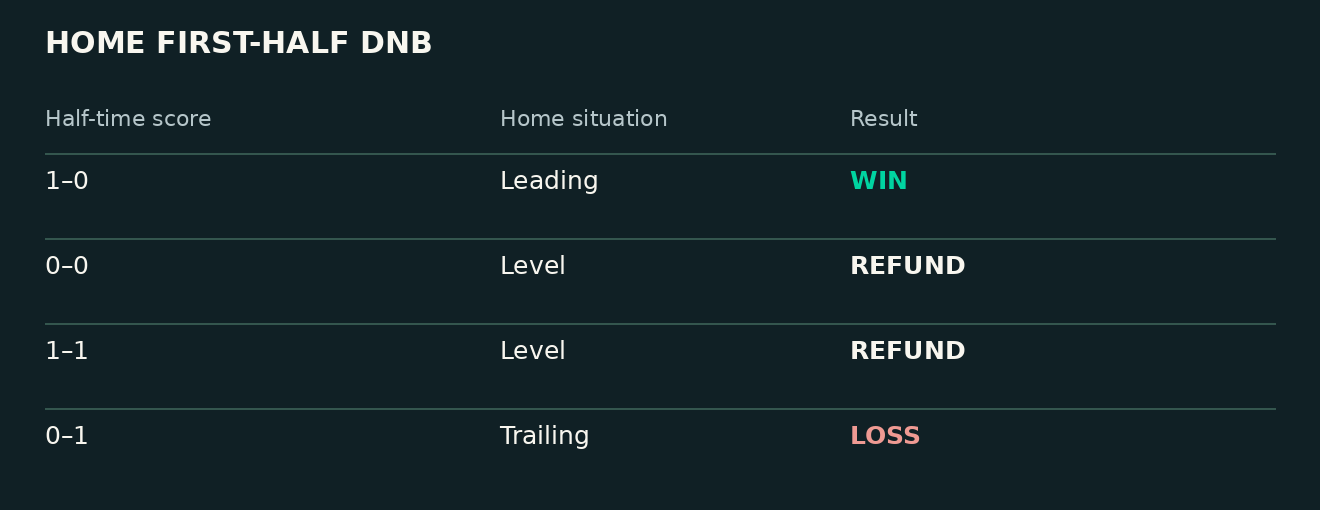
Educational examples. The half-time score is the relevant result.
For an away-team selection, reverse the winning and losing situations. A 0–1 half-time score wins Away FC first-half DNB; 1–0 loses it. A draw remains a refund for either side.
The market does not require your team to score a particular number of goals. In the ordinary example, 1–0 and 3–0 are both leads. A draw can be goalless or contain goals: 0–0 and 2–2 are both level scores.
Why the final score does not rescue a first-half loss
Imagine Home FC trails 0–1 at half time, then wins the match 2–1. Your first-half Home FC DNB selection lost. A separate full-time Home FC DNB selection would have a winning result under its own terms.
Now reverse the story. Home FC leads 1–0 at the break but loses 1–2 at full time. The first-half selection has a winning first-half result even though the separate full-time selection loses.
| Hypothetical match | First-half Home DNB | Full-time Home DNB |
|---|---|---|
| HT 0–1; FT 2–1 | Loss | Win |
| HT 1–0; FT 1–2 | Win | Loss |
| HT 0–0; FT 2–0 | Refund | Win |
These are two markets, not two ways to report one result. Keep them in separate records if you track forecasts. A full-time probability estimate cannot automatically be used as a first-half estimate.
What happens to a 100-unit stake?
Use a hypothetical cash stake of 100 units at first-half DNB odds of 1.80. A winning return includes the original stake.
| First-half result for your team | Total returned | Net outcome |
|---|---|---|
| Leads at half time | 180 | +80 profit |
| Level at half time | 100 | 0 profit; stake refunded |
| Trails at half time | 0 | −100 loss |
The winning arithmetic is 100 × 1.80 = 180 returned, then 180 − 100 = 80 profit. The refund row does not multiply your stake by 1.80.
The calculation is the same in neutral units or a chosen currency, before any applicable deductions. It excludes taxes, fees, commission and special promotion terms. A bonus stake may not behave like an ordinary cash stake.
First-half DNB vs first-half double chance
For the same home team and first-half period, DNB refunds a half-time draw. First-half double chance 1X treats a home lead or a draw as a winning outcome. Both lose if the away team leads at the break. Combining a double chance with both teams to score changes the settlement again: see how.
Do not confuse this with full-time 1X: a first-half lead does not establish that the home team will avoid defeat over the whole game. Also check the selected pair: 12 covers either team leading and excludes the draw.
Bet9ja's football rules list first-half DNB and first-half double chance separately. Read the football first-half market descriptions.
For a fuller comparison of refunds and winning returns, read the separate guide Draw No Bet vs Double Chance. Its general comparison still needs the period matched to your selection.
Does first-half stoppage time count?
For an ordinary first-half market, the first half includes its added time. A goal in first-half stoppage time can therefore change the half-time result. That does not mean goals after the break count.
Check the operator's period rules rather than treating 45:00 as an automatic settlement boundary. Bet9ja's football terms describe scheduled play plus injury time; special market wording can alter the scope. The first-half whistle, a displayed score and a final account settlement are not necessarily the same instant.
If the half is interrupted, abandoned or later corrected, consult the applicable event rules. Do not assume a screenshot guarantees final settlement or that every unfinished match is handled identically.
What if first-half DNB is in an accumulator?
A refund leg is not a profitable win. Under standard Betfair Sportsbook multiple rules, a void leg is removed and the remaining selections stand. Special builders or promotions can differ. Read Betfair's multiple-bet rules.
For an educational example, suppose a 100-unit accumulator contains two winning legs at 1.50 and 1.60 and one void first-half DNB leg. The remaining price is 1.50 × 1.60 = 2.40, giving 240 returned and 140 net profit before deductions. If a remaining leg loses, the accumulator does not become a winning payout just because DNB refunded.
Questions to ask before using a forecast
- Does the probability refer to the first half or the full match?
- Which team is selected, and how is the score ordered?
- Is a draw a refund or a winning result in this market?
- Are you comparing total returns, profit or win rates excluding pushes?
- Have you checked the actual operator's rules and any special conditions?
First-half DNB can still lose the entire stake. A shorter period is not proof of an easier forecast. Understanding settlement does not establish that the offered price is favourable.
Common questions
Does 0–0 at half time refund first-half DNB?
For an ordinary cash first-half DNB selection, yes. It is a level first-half result. A later goal does not turn that refund into a winning first-half payout.
Can my team win the match while my first-half DNB loses?
Yes. Trailing at half time and winning after the break are compatible results. The two periods must be evaluated separately.
Is first-half DNB the same as half-time/full-time?
No. HT/FT asks for a combination of first-half and full-time results. First-half DNB asks about the first half with a refund condition for a draw.
Explore the analysis behind the numbers
Explore ProofPitch or open the Telegram bot. Check what each estimate represents before comparing it with a price or result history. This guide does not claim that ProofPitch currently offers a specific first-half market.
Related guides
- Draw No Bet vs Double Chance: Difference & Examples: the full-time comparison of refunds and winning returns.
- Double Chance & Both Teams to Score: Meaning & Examples: reading combined markets and their period labels.
Sources and editorial method
Rules were checked against the official Bet9ja and Betfair pages linked above on 12 October 2026. These are rule references, not operator endorsements. Match stories and calculations were created for this educational guide and recalculated from the stated assumptions. The article was prepared with AI assistance; no personal betting record or human expert review is claimed.
18+ or the higher legal age where you live. Educational analytics, not a guarantee of results. Betting involves a risk of loss. Do not chase losses or use money needed for essentials.