Double Chance & Both Teams to Score: Meaning & Examples
Understand double chance and both teams to score with 1X, X2 and 12 examples, BTTS Yes/No differences and clear payout calculations.


Double chance and both teams to score is one combined selection with two conditions. If you choose 1X & BTTS Yes, the home team must win or draw and both teams must score. A 1–0 home win fails the BTTS condition. A 1–2 away win fails the 1X condition.
This guide uses ordinary full-time football examples and decimal odds. All scores, stakes and prices are hypothetical. They are not live offers or ProofPitch forecast results. Actual market wording and operator rules control settlement.
What does double chance & BTTS mean?
Double chance covers a pair of result outcomes. Both teams to score, shortened to BTTS, describes whether each team scores at least one goal during the specified period. Combining them requires the selected pair and the selected scoring condition to hold together.
Bet9ja calls this “Double Chance + Goal/No Goal” and describes predicting both the match outcome pair and whether both teams score. See the DC & GG/NG section of its football rules.
The word and matters. This is not a choice between being right about the result and being right about goals. If only one condition is correct, the ordinary combined selection loses.
For example, a draw may be acceptable for 1X, but a 0–0 draw does not satisfy BTTS Yes. Likewise, both teams scoring does not save 1X when the away team wins.
Decode 1X, X2 and 12 first
| Double chance pair | Covered results | Excluded result |
|---|---|---|
| 1X | Home win or draw | Away win |
| X2 | Away win or draw | Home win |
| 12 | Either team wins | Draw |
SportPesa's official terms define these three pairs. For a full comparison with draw no bet, read Draw No Bet vs Double Chance. Read its Double Chance market definition.
BTTS Yes adds the requirement that both sides score. BTTS No means at least one side does not score; it does not require both teams to finish goalless. The scoring condition and the result pair need to be read separately, then checked together.
How 1X & BTTS Yes settles
Use the home score first in every example below.
| Full-time score | 1X correct? | BTTS Yes correct? | Combined result |
|---|---|---|---|
| 2–1 | Yes | Yes | Win |
| 1–1 | Yes | Yes | Win |
| 1–0 | Yes | No | Loss |
| 0–0 | Yes | No | Loss |
| 1–2 | No | Yes | Loss |
| 0–2 | No | No | Loss |
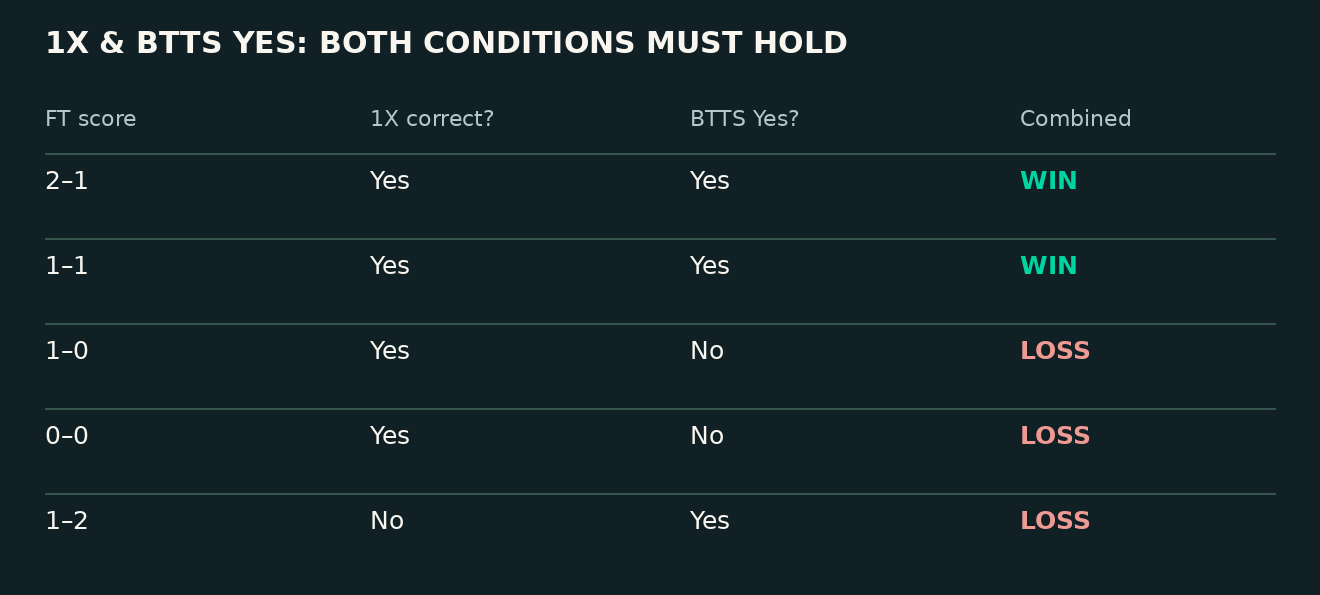
Educational score examples, not actual match recommendations.
A 1–1 draw is a winning example because the home team has avoided defeat and each side has scored. A 0–0 draw has the same match-result category but a different scoring condition. It loses this selection rather than generating a DNB-style refund.
The table illustrates why “double chance” in the name does not make the combination equivalent to ordinary 1X. The extra condition removes some otherwise winning scores.
What changes for X2 & BTTS Yes?
X2 covers an away win or a draw. It can win at 1–2, 2–3 or 1–1 when both sides score. A 0–1 away win fails BTTS Yes even though X2 is correct. A 2–1 home win fails X2 even though both teams scored.
When changing from 1X to X2, do not reuse the home-team logic by accident. Identify which side can win without invalidating the result pair. A scoring draw satisfies either pair when BTTS Yes is selected.
Why 12 & BTTS Yes is different
12 requires a winner. For 12 & BTTS Yes, both teams must score and the match must not finish level. A 2–1 or 1–2 result satisfies both conditions; 1–1 and 2–2 do not.
This is the common exception to the idea that double chance covers the draw. The label 12 excludes it. Read the pair before interpreting the scoring part of the market.
What does double chance & BTTS No mean?
For 1X & BTTS No, the home team must win or draw while at least one team fails to score. A 1–0 home win and 0–0 draw fit. A 1–1 draw does not, because both teams scored.
| Hypothetical score | 1X & BTTS Yes | 1X & BTTS No |
|---|---|---|
| 1–0 | Loss | Win |
| 0–0 | Loss | Win |
| 1–1 | Win | Loss |
| 1–2 | Loss | Loss |
BTTS No is not the same as under 2.5 goals. A 3–0 result has more than two goals but only one scoring team. A 1–1 result has fewer than three goals but both teams scoring. Result conditions and total-goal conditions are different questions.
How the payout is calculated
Imagine an ordinary cash single of 100 units on 1X & BTTS Yes at hypothetical combined odds of 2.20.
- If both conditions hold, total return is 100 × 2.20 = 220 units. Net profit is 120.
- If either condition fails, total return is zero and the loss is 100 units.
- An event void or promotional settlement is a separate rules question, not an ordinary score outcome.
Use the displayed price for the combined selection. Do not multiply a standalone 1X price by a standalone BTTS price and assume that is the offered combined price. The same match generates both events, so their relationship can affect pricing. Taxes, fees, exchange commission and special offers are excluded from this example.
Can you multiply the two probabilities?
Not without a justified independence assumption. A win-or-draw event and both teams scoring are connected through the score of the same game.
For an original educational example, suppose P(1X) is 70% and P(BTTS Yes given 1X) is 60%. Then:
P(1X and BTTS Yes) = 0.70 × 0.60 = 42%.
The second figure is a conditional probability, not simply a general BTTS percentage. If you only know the two separate headline probabilities, you do not yet know the probability of their intersection.
With this assumed 42% combined chance and odds of 2.20, expected net return on 100 units is 0.42 × 120 − 0.58 × 100 = −7.60 units. A selection can have attractive-looking odds and still have a negative expected return under the assumptions.
These estimates are hypothetical and can be wrong. Expected return is not a prediction of the next result. Neither a combined price nor a model confidence label makes the selection certain.
Period labels can change the answer
The examples above use full time. A first-half version checks the result and goals in the first half only; the first-half draw no bet guide shows how period labels work for refunds. Both teams scoring after the break would not fulfil first-half BTTS Yes.
Bet9ja lists first- and second-half combinations separately. For ordinary full-time football, SportPesa's terms define the relevant regulation-time scope. Extra time, penalties, abandonment and special markets require checking the applicable rules rather than assuming every selection uses the same period.
Do not confuse a named combined market with two independent bets, a general accumulator or a promotion. A builder may have specific void-leg and settlement terms.
A useful check before reading a forecast
- Identify the result pair: 1X, X2 or 12.
- Identify the scoring condition: BTTS Yes or No.
- Confirm that both conditions refer to the same period.
- Test a score that gets one condition right and the other wrong.
- Compare probabilities for the actual combined event, not unrelated headline numbers.
Common questions
Does 0–0 win double chance & BTTS Yes?
No. It can satisfy 1X or X2, but it fails BTTS Yes. For 12 it also fails the result condition.
Does 1–1 win 12 & BTTS Yes?
No. Both teams scored, but 12 excludes draws. For 1X & BTTS Yes or X2 & BTTS Yes, the same score fits the conditions.
Does BTTS mean both teams score in both halves?
Not in an ordinary full-time BTTS market. Both sides need to score during the specified match period, not necessarily in each half. A “both halves” label would add a different requirement.
Explore the numbers with ProofPitch
Explore ProofPitch or open the Telegram bot. Always check what the probability represents before applying it to a combined selection. This guide does not claim that ProofPitch currently supplies this exact market or its joint probability.
Related guides
- Draw No Bet vs Double Chance: Difference & Examples: the basics of 1X, X2, 12 and refunds.
- First-Half Draw No Bet: Meaning, Refunds & Examples: what changes when only the first half counts.
Sources and editorial method
Official Bet9ja and SportPesa rules linked above were checked on 12 October 2026. They establish definitions and period scope, not profitability. Score tables and probability calculations are original educational examples, checked for logical consistency and arithmetic. This article was prepared with AI assistance and does not claim human expert review or an actual forecasting record.
18+ or the higher legal age where you live. Educational analytics, not a guarantee of results. Betting involves a risk of loss. Do not chase losses or use money needed for essentials.