Betting tips vs probabilities: what a tip leaves out
Learn what football betting tips leave out, how probability connects to price, and why hit rate alone cannot validate a forecast.


Betting tips tell you what someone would select. A probability forecast tells you how often the stated event is expected to occur across comparable cases. Neither number is useful for a price decision until it is compared with the odds available at a defined time.
That is the central difference between “Team A to win” and “Team A to win: 60%”. The first is a direction. The second is a testable estimate. Add a price and you can calculate the success rate required to break even before costs. You still cannot know the result of the next match.
Tip, probability and calculated price are different things
These terms are often placed on one card, but they answer different questions.
| Item | What it answers | Example | What it does not prove |
|---|---|---|---|
| Tip or pick | Which outcome is selected? | Home win | How likely it is or whether the price is attractive |
| Model probability | How often should the event occur in comparable cases, according to the model? | 60% | That this particular match will win |
| Fair decimal price | What price corresponds to that probability before margin? | 1 ÷ 0.60 = 1.67 | A price that any bookmaker must offer |
| Market price | What decimal odds were available from a stated source and time? | 1.80 | The model's own estimate |
| ProofPitch calculated price threshold | What market-based reference results after the documented 5% margin rule? | Labelled calculation | A live bookmaker quote or a value that is certain |
A football tip may come from a model, an analyst, team news, a market screen or intuition. The label alone does not describe the method. “Expert” is also not a measurement: an expert prediction becomes auditable only when the forecast, time, probability and evaluation rule are recorded before the result.
Probability makes the claim testable
Suppose a model assigns 60% to a defined event. That does not mean the event is “safe”. If the estimate is well calibrated, events in that band should still fail about 40 times in every 100 comparable forecasts over a sufficiently large sample.
Calibration is the relationship between forecast probabilities and observed frequencies. Football forecast verification also uses proper scoring rules, including Brier and logarithmic scores, because they evaluate the probability assigned rather than only whether the top pick won.[1] Gneiting and Raftery show why proper scoring rules encourage a forecaster to report its genuine probability assessment rather than game the evaluation.[2]
Fair price is a translation, not an operator quote
For a single decimal price, the basic conversions are:
- fair decimal price = 1 ÷ model probability;
- raw implied probability = 1 ÷ decimal odds.
The word “fair” here means before bookmaker margin and other market effects. In a multi-outcome market, raw implied probabilities commonly add to more than a complete probability total, so each price should not be treated as a clean consensus probability without adjusting for overround.
How to compare a tip with the market: 1.80 versus 1.55
Consider one hypothetical tip: Home win. The model probability is fixed at 60%, so the model's fair price is:
1 ÷ 0.60 = 1.6667, rounded to 1.67.
Now compare two prices for the same outcome.
| Same event | Model probability | Decimal price | Raw break-even rate | Theoretical value per 1 unit* |
|---|---|---|---|---|
| Home win | 60% | 1.80 | 55.56% | +0.08 |
| Home win | 60% | 1.55 | 64.52% | −0.07 |
\*Theoretical value uses probability × decimal price − 1. It assumes the 60% estimate is correct and ignores model error, market limits, price movement and execution. It is an explanation, not a recommendation or expected personal return.
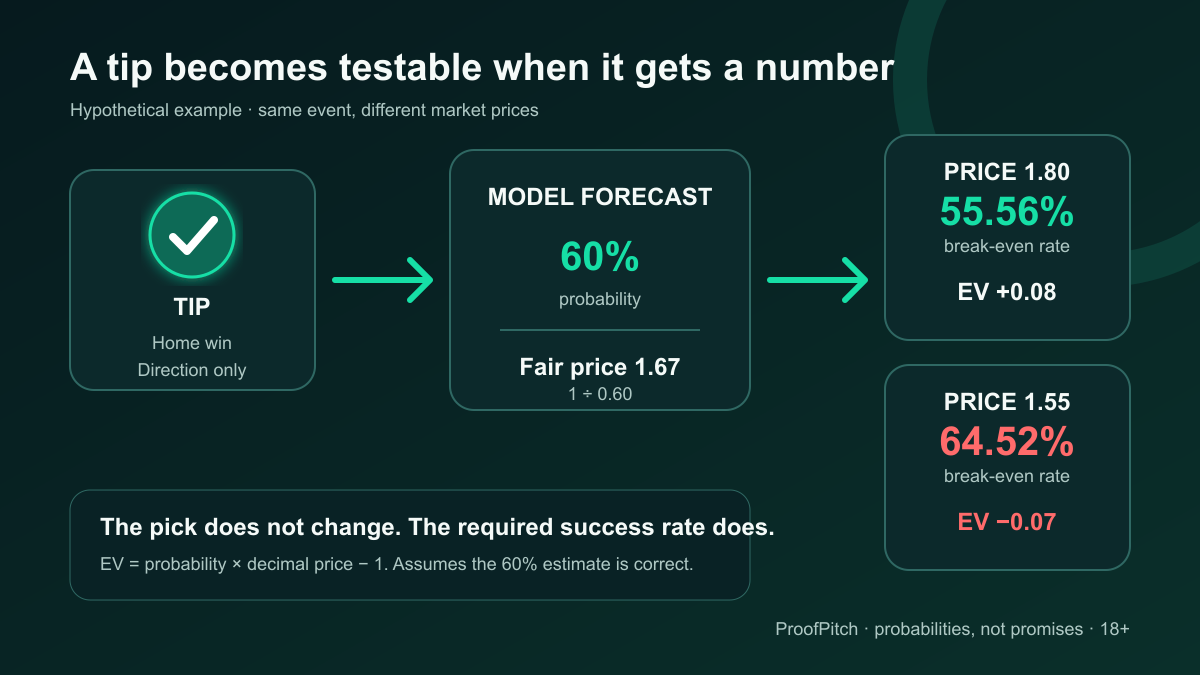
Figure 1. The selection stays the same, but the break-even requirement changes with the price. Values are hypothetical.
At 1.80, the raw break-even rate is 1 ÷ 1.80 = 55.56%. If the model's 60% estimate were accurate, the difference is 4.44 percentage points. At 1.55, the required rate is 1 ÷ 1.55 = 64.52%, which is above the model estimate.
This is why a tip can never be evaluated independently of price. “Home win” at 1.80 and “Home win” at 1.55 are the same football opinion but different mathematical propositions.
The comparison also has a time dimension. Betting tips today may be published hours before kick-off, while injuries, line-ups and market activity can move the price. A quoted price needs a source and timestamp. UK ASA/CAP tipster guidance is not African law, but it is a useful evidence standard: it warns that promoted odds should have been available long enough for users to act and that past success claims need complete, pre-event evidence.[3]
Where football betting tips come from
There is no single production method behind football betting tips or soccer tips. Common sources include:
- Analyst judgement. An individual weighs tactics, injuries, schedules and context. The reasoning can be valuable, but it needs a numeric estimate to be compared and audited.
- Statistical models. A repeatable process converts inputs into outcome probabilities. A model can still be poorly specified, stale or overfitted.
- Market-following rules. A service may copy short prices, line movement or consensus. A high hit rate can then reflect already-favoured outcomes rather than new information.
- Content or affiliate selection. A publisher may prioritise popular fixtures or commercially useful markets. That incentive should be disclosed; it does not validate or invalidate the forecast by itself.
- Unrecorded intuition. A pick can be based on experience, but without a timestamped record and stable rules its performance cannot be reproduced.
The responsible question is not “human or model?” It is “what exactly was forecast, when was it fixed, and how will every eligible result be evaluated?”
Why hit rate without a baseline means little
Hit rate counts correct selections. It does not account for the difficulty implied by the price.
Imagine two hypothetical ten-tip records with one-unit stakes:
| Record | Correct | Typical decimal price | Total return | Net result |
|---|---|---|---|---|
| A | 8 of 10 (80%) | 1.10 | 8 × 1.10 = 8.80 | −1.20 units |
| B | 6 of 10 (60%) | 1.80 | 6 × 1.80 = 10.80 | +0.80 units |
Record A has the higher hit rate but the lower return in this simplified example. Record B's positive result does not prove a profitable method: ten observations are a tiny sample, and price availability, market margin, voids and staking rules matter.
For any claimed record, ask for:
- the number of settled tips and the complete date range;
- the market and settlement rule for each selection;
- the price source and pre-match timestamp;
- losses, voids and cancelled events, not only wins;
- the staking rule if return is reported;
- comparable benchmarks, such as the market's raw implied rate;
- separate reports for live publication and retrospective testing.
“Nine wins yesterday” is not enough. Neither is “72% accurate” without the denominator, market mix and prices. Short winning runs occur by chance, and an evaluation period chosen after the results can exaggerate performance.
“Free” and “expert” describe the offer, not the forecast quality
The phrase free betting tips describes access. It does not establish accuracy, independence or good methodology. A paid subscription also does not establish those qualities. Evaluate both with the same evidence.
Likewise, expert betting tips may contain thoughtful analysis, but the title “expert” cannot replace a probability, a timestamped history or a clear performance baseline. Opinions should not be presented as measured facts.
How ProofPitch presents a forecast
ProofPitch is designed to keep the selection, probability and price reference separate.
- Defined event. The card states the match, market and settlement scope.
- Model probability. The output is numeric, so it can later be checked for calibration and scored.
- Calculation time. The record shows when the forecast was produced, before the event.
- Market reference. Any market observation needs a source and time because prices move.
- Calculated price threshold. ProofPitch's card uses a documented market-based calculation with a 5% margin. It is labelled as a calculated value, not as a bookmaker quote.
- Public outcome record. Eligible published forecasts retain both successful and unsuccessful settlements.
- Separate evidence sets. Live performance and retrospective model checks are presented separately; a backtest is not described as a live record.
Read how a mathematical football prediction works for the modelling layer. Then use the live record and retrospective checks as different forms of evidence.
This format does not make the next outcome certain. It makes the forecast inspectable. A model probability is an estimate, a calculated threshold is an analytical reference, and the price available to a user can differ by operator, account and time.
Frequently asked questions
What are betting tips?
Betting tips are suggested selections for a defined market, such as a home win or over 2.5 goals. A tip may come from opinion or a model. By itself, it does not state the probability, required break-even rate or quality of the available price.
Are football tips the same as predictions?
Not necessarily. A pick identifies one selection. A probabilistic forecast assigns numbers to defined possible outcomes. The probability can be evaluated for calibration and compared with a price; a bare pick cannot show how strong the forecast is.
What probability is implied by decimal odds of 1.80?
The raw implied probability is 1 ÷ 1.80 = 55.56%. This is a break-even calculation before adjusting for market overround, fees or other factors.
Why can the same tip be reasonable at 1.80 but not at 1.55?
Because 1.80 requires a raw success rate of about 55.56% to break even, while 1.55 requires about 64.52%. If a model estimates the event at 60%, the two prices sit on opposite sides of that estimate. The model can still be wrong.
Is a high hit rate proof that betting tips work?
No. Hit rate depends on the prices and markets selected. It also needs a meaningful, consecutive sample with fixed rules. An 80% record built from very short prices can have a worse return than a lower hit rate at larger prices.
Do betting tips today become outdated?
They can. Team news and market prices can change before kick-off. A responsible record preserves the original forecast and timestamp rather than silently rewriting it. A current decision should use current, independently checked information.
Are free betting tips less accurate than paid tips?
Access price does not determine forecast quality. Check the same evidence for either: probability, timestamp, complete history, sample size, price source, settlement rules and commercial disclosures. This article does not claim that ProofPitch offers a free tier.
Are expert predictions better than model forecasts?
The labels do not decide quality. Expert judgement may capture context that data misses; a model may apply rules more consistently. Both need pre-event records and a fair evaluation. A combined process should state where human judgement changes model output.
A number does not remove uncertainty—but it reveals it
A useful forecast does more than name a side. It defines the event, quantifies uncertainty and records the claim before the result. Only then can the reader compare the estimate with a price and judge the evidence over time.
Open ProofPitch to inspect a forecast as a probability-led record rather than a standalone tip. Check the event, calculation time and price labels before making any decision.
18+ only. Participate only where legal. Gambling involves a risk of loss. Set time and money limits, never chase losses, and do not treat tips or probabilities as income, employment or financial advice. If gambling is causing harm, stop and contact an appropriate local support service.
Notes and sources
- Foulley, J.-L. More on verification of probability forecasts for football outcomes. Reference for reliability analysis and probability scoring in football forecasts.
- Gneiting, T.; Raftery, A. E. Strictly Proper Scoring Rules, Prediction, and Estimation. Journal of the American Statistical Association, 2007.
- ASA/CAP. Gambling, betting and gaming: Tipsters. UK advertising guidance used as an evidence benchmark, not as law for Nigeria, Ghana or South Africa. Checked 28 October 2026.