Best football prediction sites: a verification checklist
Learn how to assess football prediction sites using timestamps, complete records, sample size, calibration and honest commercial disclosures.


The best prediction site is not necessarily the one with the biggest win-rate headline. The best football prediction sites make their claims testable: forecasts are fixed before kick-off, unsuccessful calls remain visible, market and settlement rules are clear, and performance is reported over a meaningful sample.
This guide gives you a practical way to compare a model-based prediction platform with a tipster, a social-media channel or a ranking page. It does not rank brands. It shows what evidence to request before you trust any ranking, including ours.
What makes a football prediction site honest?
“Honest” does not mean “always correct”. Football remains uncertain, so an honest service will be wrong regularly. Honesty means the site defines its forecast, preserves the original record and evaluates results by the same published rules each time.
Use this checklist before comparing any football prediction sites:
| Check | Evidence to look for | Red flag |
|---|---|---|
| Pre-match timestamp | Date, time and timezone recorded before kick-off | “Today’s winner” with no publication time |
| Complete history | Consecutive forecasts, wins and losses, still available | Screenshots or selected winners only |
| Fixed market definition | 1X2, BTTS or totals stated with the settlement period | A generic “match won” label |
| Sample size | Number of settled forecasts beside every percentage | A percentage with no count |
| Probabilities | A number for each outcome or market, not only a pick | “High confidence” with no defined scale |
| Consistent evaluation | Same inclusion, void and settlement rules throughout | Rules that change after the result |
| Price evidence | Source and timestamp if profit or return is claimed | An attractive price selected after kick-off |
| Model version | Version or change log when the method changes | One lifetime record across changing methods |
| Commercial disclosure | Paid tiers, affiliate links and sponsorships labelled | A “neutral” ranking that hides payment |
| Responsible framing | 18+, risk language and no income promises | Gambling presented as employment or investment |
No single row proves quality. Together, they make the service auditable.
A timestamp must lock the content, not just decorate the page
A date printed beside a forecast is useful only if the forecast itself could not be rewritten silently. A stronger record combines the original selection or probability, a pre-kick-off timestamp, a stable identifier and an append-only history.
Append-only logs are a general transparency pattern: new entries can be added, while changes to older entries become detectable. RFC 9162 describes how Merkle-tree consistency proofs can demonstrate that a later log contains the same earlier entries.[1] That technical standard concerns certificate transparency, not football, but the audit principle transfers: a hash is useful only when readers can verify the published sequence and its timing.
A screenshot does not provide the same protection. It can show what a page looked like at one moment, but it does not prove that all forecasts were captured or that losing posts were not removed.
The archive must include the denominator
If a site says “60% accurate”, ask: 60% of what?
- How many forecasts were settled?
- Which market was measured?
- Which leagues and dates were included?
- Were voids excluded consistently?
- Were multiple selections from one match counted separately?
- Did the site choose the period after seeing the results?
A record of 12 correct calls from 20 and a record of 600 from 1,000 both display 60%, but they do not carry the same statistical uncertainty. Using a 95% Wilson interval, 12/20 is compatible with a broad range of roughly 38.7% to 78.1%; 600/1,000 narrows to about 56.9% to 63.0%. Wilson intervals are a standard method for binomial proportions.[2]
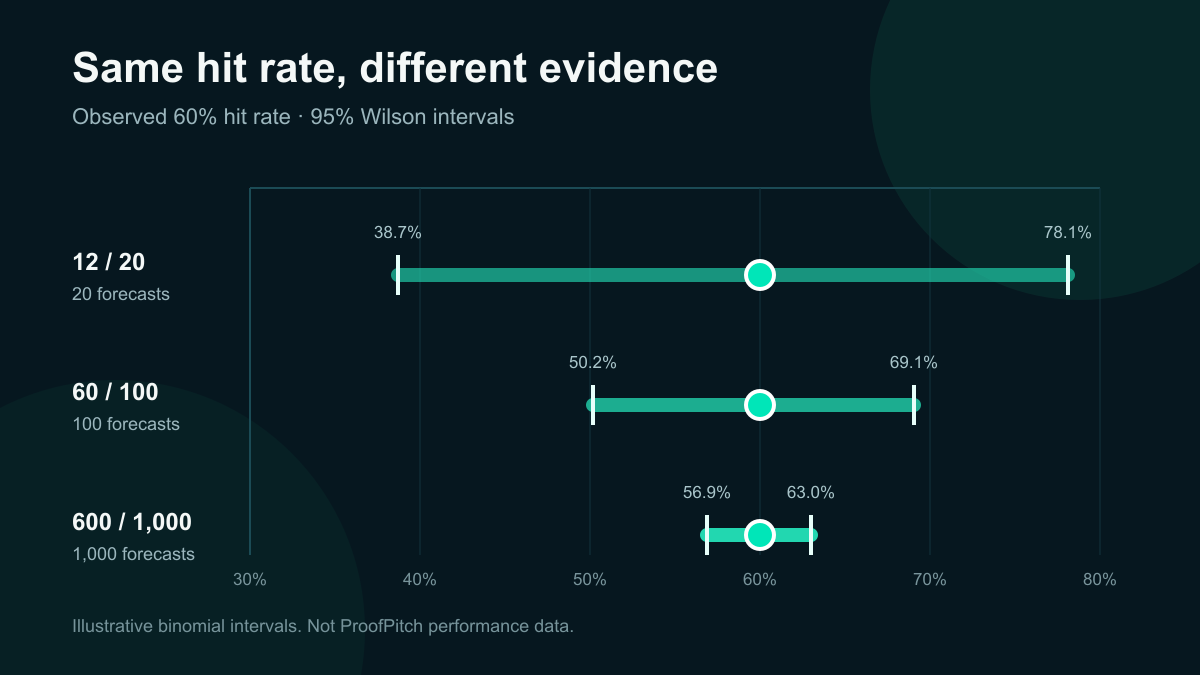
Figure 1. Same observed hit rate, different amount of evidence. Intervals are 95% Wilson intervals and are illustrative, not ProofPitch performance data.
The lesson is not that 1,000 forecasts automatically prove skill. The sample must also be relevant, consecutive and evaluated without hindsight.
Accuracy is not one number
The phrase accurate football prediction sites sounds simple, but different metrics answer different questions.
Hit rate
Hit rate is the share of selections that settled as correct. It is easy to understand, but it depends heavily on the market. A service can increase its hit rate by selecting outcomes that already have a high implied probability. Without prices and a benchmark, the number does not show whether the forecasts added information.
Never compare a 1X2 hit rate directly with double-chance, over 1.5 goals or another easier-to-land market. Compare like with like.
Calibration
Calibration asks whether stated probabilities match observed frequencies over many forecasts. If a site’s 60% forecasts succeed about 60% of the time across a sufficiently large and relevant sample, that band is calibrated. It still loses about four times in ten.
Football forecast research uses reliability analysis and proper scoring rules such as Brier, ranked probability and logarithmic scores to evaluate probability forecasts.[3] Proper scoring rules reward useful probability distributions rather than only the winning label; Gneiting and Raftery explain why they encourage a forecaster to report its genuine probability assessment.[4]
Return or profit claims
A profit claim needs more evidence than a hit rate. At minimum, the record must preserve:
- the price available when the forecast was published;
- the source and timestamp of that price;
- the staking rule;
- all losing stakes;
- void and cancellation treatment; and
- the full evaluation period.
The UK Advertising Standards Authority’s tipster guidance is not African law, but it is a useful evidence benchmark: it warns against cherry-picked winning periods, unsupported success claims and prices that users could not reasonably obtain, and it recommends independent pre-event proofing of track records.[5]
A percentage without this ledger is marketing copy, not a reproducible result.
Why “never lose” and “100 sure” do not exist
Searches such as prediction site that never lose reveal a real user concern, but the premise is impossible for an honest football forecast. A probability is not a promise. Even an event estimated at 80% should fail about one time in five if the estimate is well calibrated.
Common ways an apparently perfect record can be created include:
- Deleting losses. Only successful posts remain visible.
- Posting several conflicting selections. The winner is highlighted later.
- Changing the market. A vague prediction is reinterpreted after the score is known.
- Selecting the time window. A short winning sequence replaces the complete record.
- Backfilling timestamps. A page date appears historical, but there is no external proof it existed before kick-off.
- Ignoring unavailable prices. Profit is calculated at a number readers could not obtain.
- Combining incompatible samples. Easy markets inflate the headline beside harder markets.
Regulatory guidance in the target markets points in the same responsible direction. Ghana’s Gaming Commission guidelines require gambling advertising not to be misleading or create the impression of assured wins, and to carry 18+ and responsible-gambling warnings.[6] South Africa’s National Gambling Board restates that its advertising regulation bars ads that imply certain success or present gambling as a solution to financial hardship.[7]
These sources do not decide which prediction model is best. They reinforce a simpler rule: claims should be verifiable, risk should be visible and uncertainty should not be disguised as income.
Prediction model or tipster: what is the difference?
A tipster usually gives a selection: home win, over 2.5, BTTS or another pick. The reasoning may be expert opinion, data, news or intuition. A model-based site can also display a selection, but its useful output is the probability distribution and the repeatable method behind it.
Neither label establishes quality. A thoughtful analyst can document work carefully, while an automated system can publish opaque numbers. Compare the evidence:
| Question | Testable model-based site | Typical unverified tipster feed |
|---|---|---|
| Is the forecast numeric? | Probabilities or a defined score | Pick or confidence adjective |
| Is the method repeatable? | Inputs, scope and version described | Personal judgement may be undefined |
| Are all calls preserved? | Consecutive public archive | Selected posts or screenshots |
| Can performance be reproduced? | Exportable or inspectable ledger | Headline claims only |
| Are errors analysed? | Calibration, scoring and failure cases | Losses explained individually or omitted |
This table describes evidence patterns, not every person or platform. The decisive question is whether an independent reader can reproduce the claim.
A five-minute audit of any prediction site
You do not need to understand machine learning to perform a useful check.
1. Open an old date before looking at the score
Choose a date from several weeks or months ago. Confirm that the page lists consecutive matches and includes publication times. Avoid starting with a “best wins” page selected by the publisher.
2. Record a small consecutive sample
Take the next 20 eligible forecasts exactly as they appear. Write down the market, probability or confidence label, timestamp and result. Twenty is not enough to estimate long-run quality; it is enough to detect missing fields, changing rules or disappearing losses.
3. Check the settlement rule
For each forecast, confirm whether it refers to 90 minutes, extra time, a goals line or another defined market. A prediction cannot be scored honestly if the event changes after the result.
4. Recalculate one headline
If the site claims 65% from 200 forecasts, the archive should contain 130 correctly settled forecasts under the stated rule. If it reports return, you should also be able to reproduce stakes, prices and voids. Small rounding differences are normal; missing records are not.
5. Inspect the business model
Paid access is not automatically a problem, and free access is not automatically trustworthy. Check whether the site earns from subscriptions, advertising or bookmaker referrals. Rankings and recommended operators should identify affiliate relationships. A commercial incentive does not invalidate evidence, but hiding it prevents an informed comparison.
How ProofPitch shows its errors
ProofPitch separates three layers that are often blended together:
- The pre-match forecast shows the event, model probability, calculation time and the specific market.
- The live public record keeps eligible published forecasts and their settled outcomes, including unsuccessful calls.
- The retrospective check evaluates a fixed model version on a defined historical sample and is labelled separately from live performance.
Read how mathematical football predictions work before comparing model outputs. Then inspect the live performance record and retrospective model checks as different datasets. A backtest can help test a method, but it must not be presented as if it were a live record.
ProofPitch also keeps model probability, market reference and the platform’s calculated price threshold conceptually separate. The calculated value is not a bookmaker quote. It uses a documented market-based calculation with a 5% margin and must be labelled as such.
This structure does not mean the model will be correct on the next match. It means readers can check what the model said, when it said it and how the outcome was recorded.
Frequently asked questions
What is the best prediction site?
There is no universal winner for every league and market. Prefer a site with pre-match timestamps, a complete public history, defined settlement rules, meaningful sample sizes, probability-based evaluation and clear commercial disclosures. Test its evidence before accepting its ranking.
Which is the best soccer prediction site for African leagues?
Coverage should be checked league by league. A platform that performs adequately on major European competitions may have sparse or delayed data for the NPFL, Ghana Premier League, South African Premiership or CAF competitions. Look for a separate sample and performance report for the competition you follow.
Can a reliable football prediction site still lose often?
Yes. A calibrated 60% probability still implies failure around 40% of the time across comparable cases. Reliability concerns the relationship between probabilities and outcomes over a large sample, not a perfect sequence.
Is a high win rate enough?
No. You also need the market, price, sample size, dates, settlement rules and a benchmark. Hit rates from different markets cannot be compared directly.
How can I tell whether a results history was edited?
Look for pre-match publication times, stable record identifiers, an append-only log or independently archived entries. A screenshot gallery is weaker evidence because it does not demonstrate completeness.
Are paid prediction sites more accurate than free sites?
Price does not establish forecast quality. Evaluate paid and free services with the same record, timestamp, sample-size and scoring checks. Also review cancellation terms and commercial disclosures before paying.
Does ProofPitch recommend a bookmaker?
This article does not rank or recommend operators. Any future partner relationship or affiliate link must be labelled clearly and supported by current market-specific checks.
Choose evidence over a leaderboard
A reliable football prediction site is one you can audit, not one that asks you to trust a slogan. Start with the timestamp, complete history, sample size and settlement rule. Then examine probabilities, calibration, prices and commercial incentives.
Open ProofPitch to inspect the next forecast beside its timestamp and public record. Treat every probability as an estimate, not a promise.
18+ only. Participate only where legal. Gambling involves a risk of loss. Set time and money limits, never chase losses and do not treat predictions as income, employment or financial advice. If gambling is causing harm, stop and contact an appropriate local support service.
Notes and sources
- IETF. RFC 9162: Certificate Transparency Version 2.0. General reference for append-only Merkle logs and consistency proofs; not a football-specific standard. Checked 27 October 2026.
- UK public-health technical guidance. Counts: Wilson score confidence intervals. Used only for the illustrative binomial intervals. Checked 27 October 2026.
- Foulley, J.-L. More on verification of probability forecasts for football outcomes. Reference for football forecast reliability and scoring methods.
- Gneiting, T.; Raftery, A. E. Strictly Proper Scoring Rules, Prediction, and Estimation. Journal of the American Statistical Association, 2007.
- ASA/CAP. Gambling, betting and gaming: Tipsters. UK advertising guidance used as an evidence benchmark, not African law. Checked 27 October 2026.
- Gaming Commission of Ghana. Advertising Guidelines. Checked 27 October 2026.
- National Gambling Board South Africa. Statement on gambling advertising compliance. Checked 27 October 2026.