Bookmaker Margin & No-Vig Calculator: Fair Probability
Free bookmaker margin and no-vig calculator: enter the odds of a market and get the margin, the no-margin probability and the fair odds of each outcome.

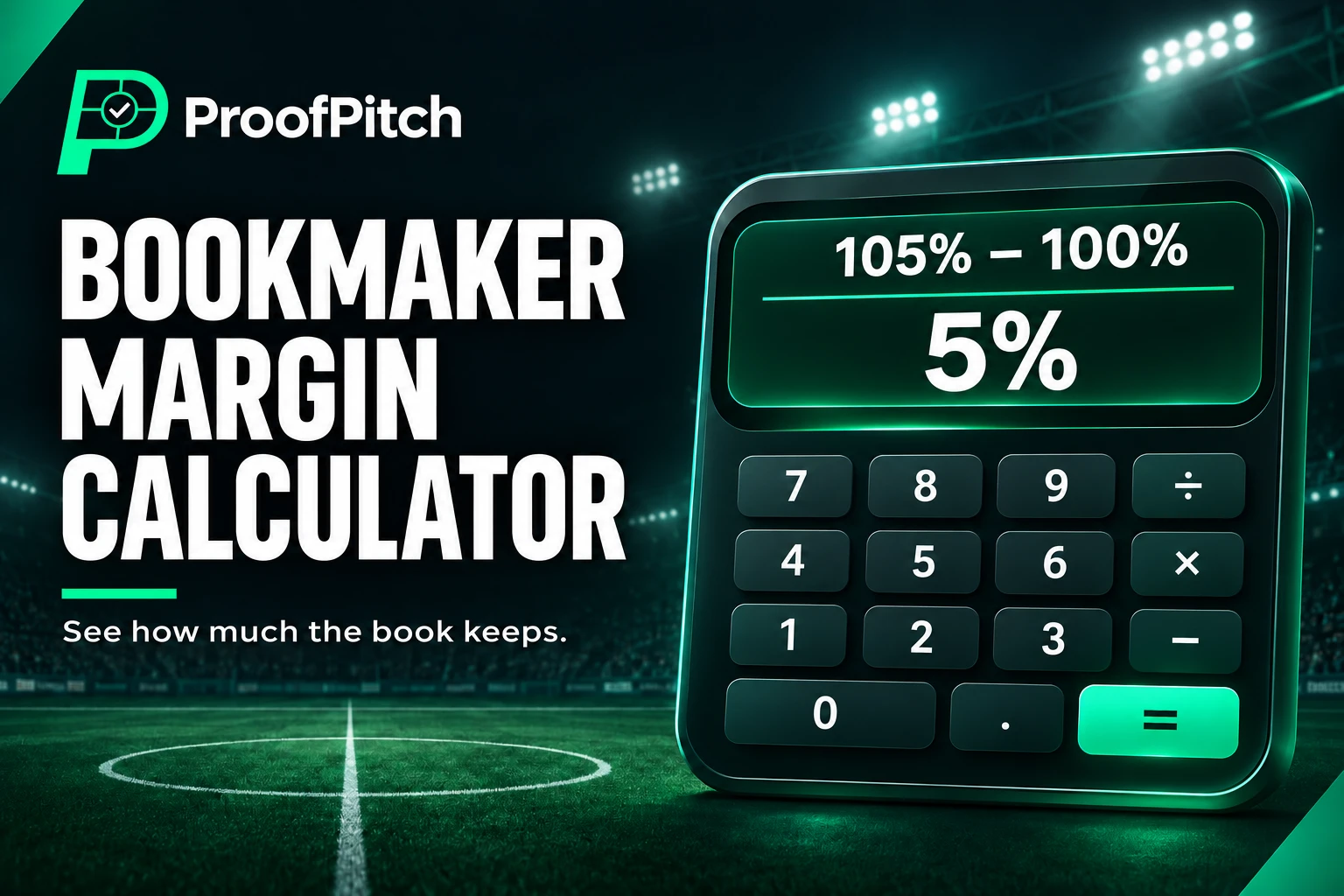
This bookmaker margin calculator (also called a no-vig or overround calculator) takes the decimal odds of a 2- or 3-outcome market and shows the margin, the theoretical payout, the no-margin probability and the fair odds of each outcome.
Bookmaker margin and no-vig probability calculator
Enter the decimal odds of one market (2 or 3 outcomes) and get the bookmaker's margin, the no-margin probability and the fair odds of each outcome.
Leave the third empty for a two-outcome market.
| Outcome | Implied prob. | No-margin prob. | Fair odds |
|---|---|---|---|
| Home | — | — | — |
| Draw | — | — | — |
| Away | — | — | — |
Simple method: the margin is spread in proportion to each probability. Other methods exist and none reveals the real probability.
How it works
Enter the odds of the outcomes of the same market, for example home, draw and away. Each price becomes an implied probability (1 / D); because the probabilities add up to more than 100%, the excess is the bookmaker's margin.[1] To remove the margin, the calculator spreads the excess in proportion to each probability: the no-margin probability is the implied probability divided by the sum of all of them.
Formulas
- Sum of implied probabilities:
S = 1/D₁ + 1/D₂ + 1/D₃. - Margin:
S − 1. Theoretical payout of the market:1 / S. - No-margin probability:
(1/Dᵢ) / S. Fair odds:1 / no-margin probability.
Worked example
Odds 2.10, 3.40 and 3.60: the implied probabilities add up to 104.81%, so the margin is 4.81% and the theoretical payout 95.41%. For the first outcome: implied probability 47.62%, no-margin 45.43% and fair odds 2.20. The other two come out at 28.06% (3.56) and 26.50% (3.77).
Things to keep in mind
- The no-margin probability is not the real probability: it is only the price with the margin taken out, by a simple method. Other methods spread the margin differently.
- The odds must come from the same market at the same moment; mixing operators or times gives meaningless results.
- A lower margin means a price closer to fair, not a better forecast.
Next steps
- With the no-margin probability as a reference, you can check whether a price has positive expected value against your own estimate.
- The margin adds up on each leg: see how margin stacks up in a parlay.
- If prices from different operators add up to less than 100%, that is the case the arbitrage (surebet) calculator checks.
- The same sum of implied probabilities is the basis for how to split a stake with dutching.
- How a model price relates to a bookmaker's: how our price is calculated.
Frequently asked questions
What is the bookmaker's margin?
The difference between the sum of the implied probabilities of all outcomes and 100%. It is what the operator builds into its prices.
How do I remove the vig from odds?
Divide each implied probability by the sum of all of them, so that they add up to 100%.
What is overround?
Another name for the margin: the sum of the implied probabilities minus 100%.
Is the no-vig probability the real one?
No. It is a market reference without the margin; the real probability is never known for certain.
To convert odds formats use the odds calculator.
18+. Take part only where it is legal. Betting carries a risk of loss. Do not treat potential returns as a budget and do not chase losses. If gambling stops being under control, stop and look for help from the support services in your country.
Notes and sources
- Pinnacle. Margin Calculator. Checked on 05/11/2026.